Scaffolding Types Explained: How to Choose the Right System for the Russian Market
Every third enquiry our export desk receives from Russia and Kazakhstan starts the same way: “Which is better — frame or cuplock scaffolding?” or “What is the difference between Ringlock and Cuplock?”. In 15 years of supplying scaffolding systems to the CIS market we have learned one thing: choosing the system type is a decision that sets your project budget, erection time and site safety for years. A mistake at this stage costs far more than the price difference between systems.
This guide explains every scaffolding type that is genuinely sold and used in Russia today — frame, cuplock, ringlock, tube-and-clamp and pin systems — with their structural differences, application zones, strengths and limits, followed by a step-by-step selection algorithm from façade area to buy-vs-rent decisions. At the end you will find a quote-request form: send your parameters and an export engineer will recommend the right type and package within 24 hours.
Why the scaffolding type drives your budget and schedule
Most buyers compare scaffolding by price per tonne or per square metre. That is the biggest mistake. The same façade area can be closed by different systems with up to 40% difference in steel weight and up to three times difference in erection speed. Here is what actually changes when you switch system type:
- Erection speed. A skilled crew of four erects 100 m² of ringlock scaffolding in one working day, frame scaffolding in one and a half to two days, tube-and-clamp in two to three days. On a site with rented cranes and paid labour, weeks of difference become money.
- Load capacity. Working load on the platform of frame scaffolding is typically 150–200 kg/m²; cuplock and ringlock reach 300–400 kg/m² and above. If pallets of brick or mortar tubs will stand on the platform, a frame system fails the calculation.
- Site geometry. Frame scaffolding with a fixed bay width suits flat façades, but on bay windows, towers, chimneys and complex geometry, freely positioned systems — cuplock and ringlock — win.
- Cost of ownership. If you buy scaffolding for years of rental or repeated use across sites, galvanizing thickness and component compatibility matter most. For a one-off façade, renting or buying frame units may be cheaper.
Frame Scaffolding: When It Is Genuinely the Right Choice
Frame scaffolding — standards with welded ledgers joined by diagonal braces and locked with flap locks — is the most common type in Russia. Dozens of factories produce it, it is cheap to manufacture, simple to erect and familiar to every crew. The classic frame bay is 1.0×1.5 m or 1.0×2.0 m with a 2.0 m lift.
Strengths:
- Lowest price — the most affordable type to buy or rent;
- Fast erection on flat façades — panels simply lock with flap locks;
- Huge second-hand market — easy to top up missing components;
- Sufficient for most façade and finishing work up to 20–30 m.
Limits:
- Fixed bay width — hard to work around bay windows, protrusions, curved surfaces;
- Working load usually limited to 150–200 kg/m²;
- Braces connect only in the vertical plane of frames — less horizontal rigidity than system scaffolding;
- Above 30 m additional ties and engineering checks are required.
Verdict: frame scaffolding is the right choice for flat façades of residential and commercial buildings, renovation and finishing work, when the budget is tight and the height does not exceed 25–30 m.
Cuplock Scaffolding: The Versatile Mid-Range System
Cuplock scaffolding joins standards with cup locks: a cup is welded to the standard, ledgers drop into the cup and a wedge is driven home with a hammer. Because of this, ledgers can be connected at any point of the standard, at any angle.
Strengths:
- Free vertical positioning of ledgers — the lift height adapts to the structure;
- Up to 4 ledgers can connect in one node — ideal for complex configurations;
- Higher load capacity than frame systems (up to 300 kg/m² working load);
- Equipment is compatible with European systems of the same class.
Limits:
- The wedge joint is sensitive to manufacturing quality: worn cups or wedges create play;
- Erection is slower than ringlock because every wedge is hammered by hand;
- Cups protrude from the standard profile — extra care needed in transport.
Verdict: cuplock is the middle ground for contractors working across different sites — residential façades, industrial buildings, structures with protrusions where more flexibility than frame is needed but the budget does not reach ringlock.
Ringlock Scaffolding: The Industry’s New Standard
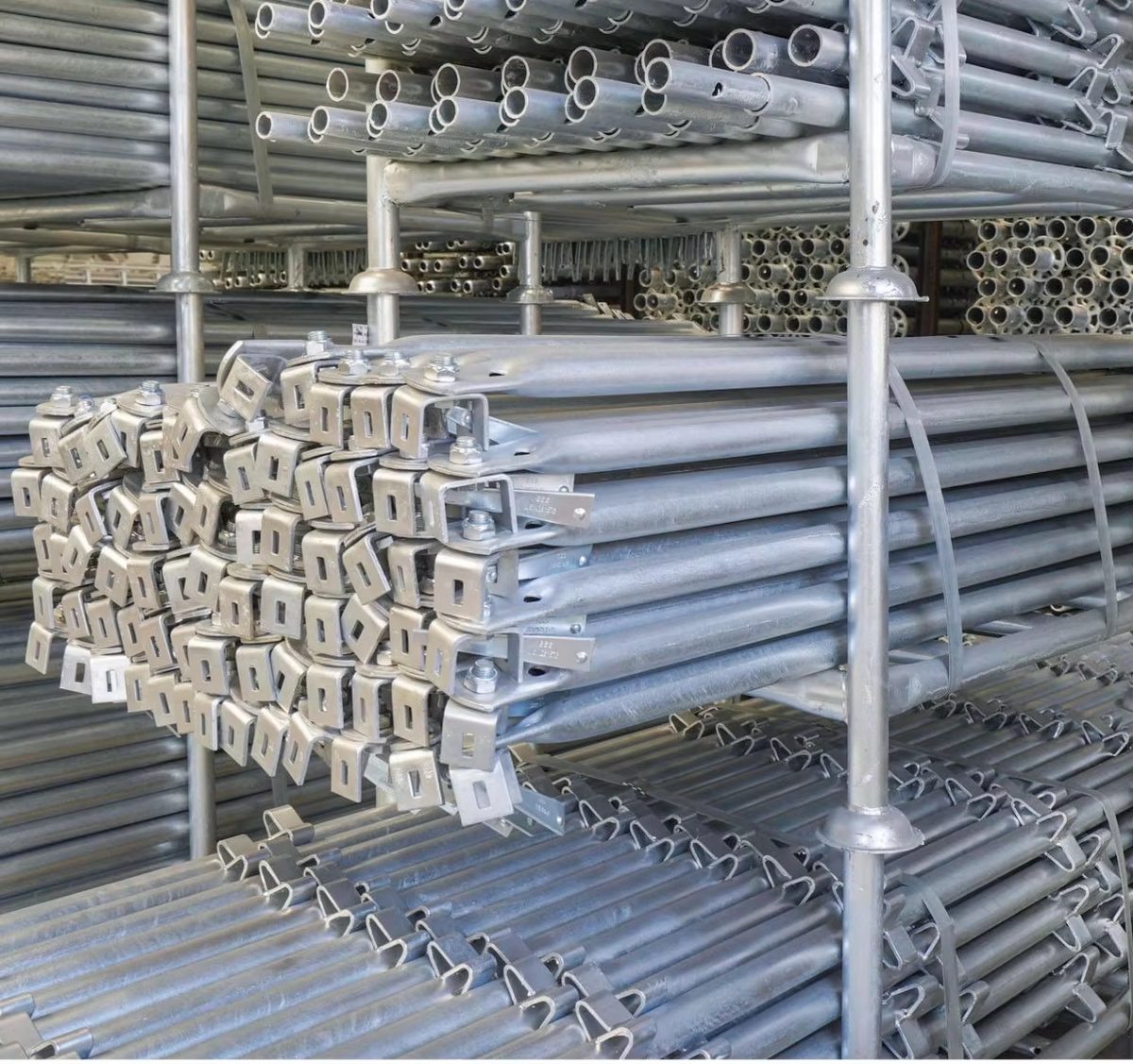
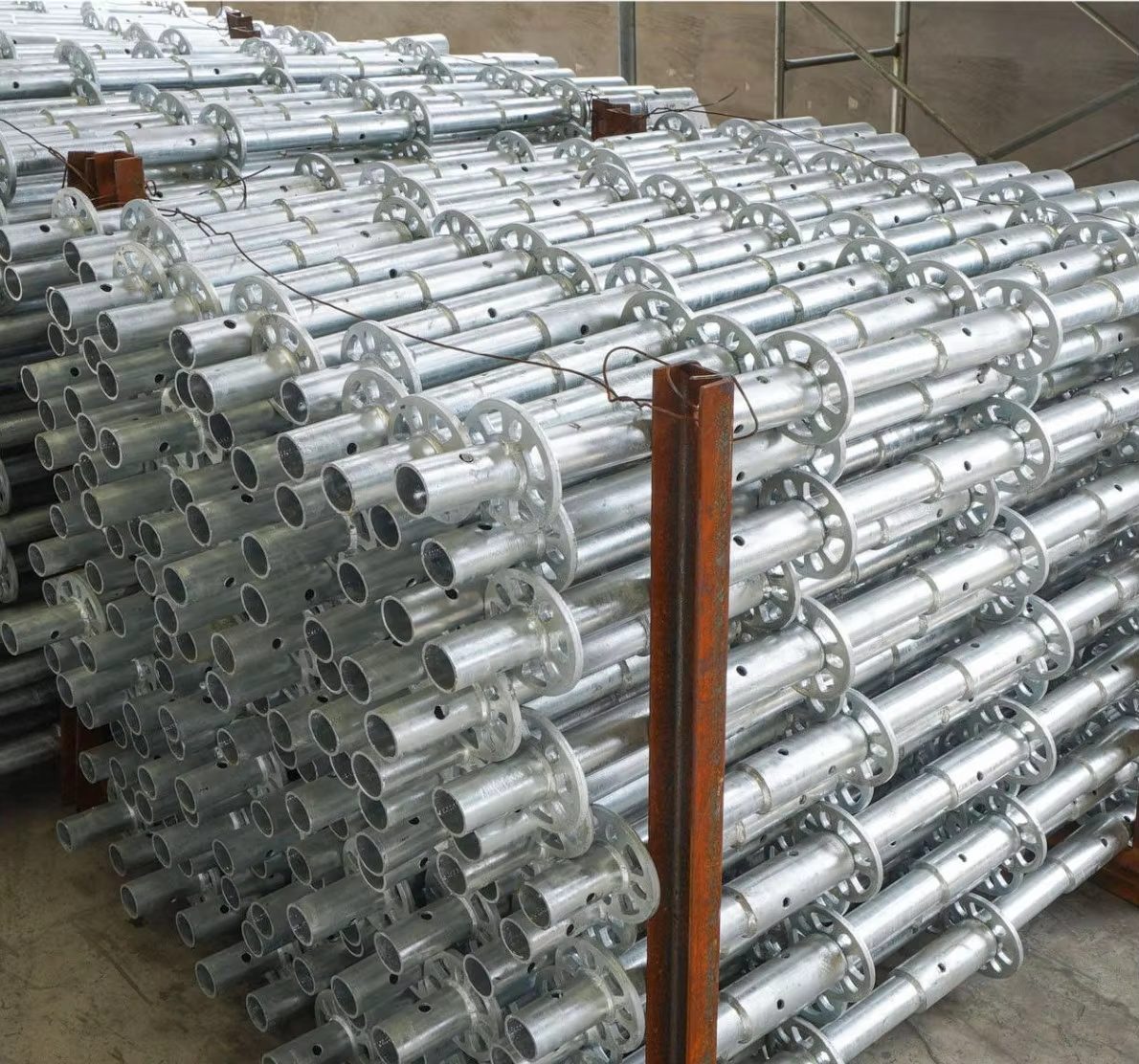
Ringlock scaffolding has become the de-facto standard of major construction in Europe and the Middle East over the past decade and is now rapidly gaining ground in Russia. The secret is in the joint: forged rosette discs with eight holes — four large and four small — are welded to the standard every 500 mm. Each ledger ends in a forged steel lock that drops over a rosette and is fixed with a wedge.
Strengths:
- Erection speed — up to 3× faster than tube-and-clamp and 1.5× faster than cuplock: one joint takes seconds;
- High load capacity — up to 400 kg/m² working load; a standard 1.5×3.0 m bay carries up to 450 kg;
- Eight holes per rosette allow up to 8 members at one node — virtually unlimited configurations;
- 500 mm module — ledgers and diagonals are standardized; the package is calculated like a construction set;
- Rigid joint — forged steel lock with wedge fixing stays play-free when correctly assembled;
- Durability — with hot-dip galvanizing per ISO 1461 (65–85 µm) the system lasts 10–15 years outdoors.
This is why, when a Moscow contractor ordered 20 containers of scaffolding from us for several sites at once, the choice fell on Ringlock — we covered that project in a separate case study.
Limits:
- 15–30% more expensive than frame and cuplock systems;
- Requires complete packages (standards, ledgers, diagonals, platforms, screw jacks) — buying “in parts” is inefficient;
- Cheap copies with thin zinc and weak rosettes exist on the market — quality must be verified with the actual mill.
Verdict: ringlock is the optimal choice for contractors and developers with continuous workloads — high-rise façades, industrial plants, stadiums, bridges — and for rental companies. It pays off through erection speed and service life. Full specifications are on our ringlock scaffolding page.
Tube-and-Clamp and Pin Scaffolding: Classics and Niches
Tube-and-clamp scaffolding is the oldest system: standards, ledgers and diagonals are joined with swivel and fixed couplers. There are no geometry limits — anything can be built from tube and couplers, including curved supports and reinforced towers. The downsides: erection takes 2–3 times longer than system scaffolding and demands highly skilled crews. Its niche — non-standard geometry, shoring supports, cantilever and curved structures, restoration works.
Pin (shaft) scaffolding — a frame system in which frames join with pins instead of locks. Simple and cheap, widely used in Soviet construction, today it is rarer: pin joints are less rigid than flap or wedge locks, and height and load are limited. More common in the used segment and on small sites.
Comparison Table: Frame vs Cuplock vs Ringlock
| Parameter | Frame | Cuplock | Ringlock |
|---|---|---|---|
| Joint | Flap lock | Cup + wedge | Rosette + forged lock |
| Lift spacing | Fixed (usually 2 m) | Free (100 mm increments) | 500 mm increments |
| Working load on platform | 150–200 kg/m² | up to 300 kg/m² | up to 400 kg/m² and above |
| Erection speed (100 m² per crew) | 1.5–2 days | 1–1.5 days | ≈ 1 day |
| Geometry flexibility | Low | Medium | High |
| Members per node | 1–2 | up to 4 | up to 8 |
| Working height | up to 30 m | up to 40–60 m | 60 m+ |
| Price | $ | $$ | $$$ |
| Typical jobs | Residential façades, finishing | Façades, industrial | High-rise & industrial, rental fleets |
How to Choose: A Scenario-Based Algorithm
- Define the purpose. Masonry and finishing up to 20 m → frame. Insulated and clad façades up to 30–40 m → cuplock or ringlock. High-rise, bridges, industrial, shoring → ringlock. Non-standard geometry → tube-and-clamp.
- Calculate the load. If pallets, mortar tubs or heavy tools go onto the platform, choose a system with a reserve — ringlock or cuplock.
- Estimate the schedule. Every extra erection day costs you the crew. On large areas the speed difference between frame and ringlock pays back the price gap within one or two months of rental.
- Decide: buy or rent. One project — count the rent. Continuous work — buy, and then zinc durability and compatibility with your existing fleet matter.
- Check the standards. Demand compliance with GOST 27321-87 (frame and pin systems) or EN 12810-1 (system scaffolding), plus a mill test certificate per EN 10204 3.1.
Standards and Quality When Importing from China
For decades the Russian market worked with domestically designed scaffolding. Today a significant share of new equipment — including ringlock and cuplock systems — is manufactured in China, and quality varies radically between factories. What to check:
- Zinc coating. Demand hot-dip galvanizing per ISO 1461 at 65–85 µm (450–600 g/m²). Thin coatings of 300–400 g/m² will corrode within 2–3 outdoor seasons;
- Material. Standards from Q355B or Q235 tube; rosettes and locks from forged steel, not stamped thin sheet;
- Welds. The rosette must be welded around the full contour with complete penetration — verifiable visually and by ultrasonic testing;
- Testing. The mill must provide node shear and pull-out test reports and a platform load test;
- Documentation. MTC per EN 10204 3.1, product passports, and an EAC declaration for the EAEU market where required;
- Completeness. System scaffolding is sold as packages: standards, ledgers, diagonals, platforms, ladders, screw jacks, ties. Confirm the package content both in tonnage and coverage area;
- Packaging. For 20-ft and 40-ft containers, scaffolding is bundled and strapped — proper packaging protects zinc in sea transit.
Case Study: 20 Containers of Ringlock for a Russian Contractor
In August 2026 our plant shipped 20×40HC containers of ringlock scaffolding — over 300 tonnes of hot-dip galvanized components — to a Moscow contractor for several sites at once. The contractor chose ringlock after comparing it with cuplock: the decisive factors were erection speed (projects were on tight schedules) and versatility — one package serves façade, high-rise and industrial work. The entire process, from specification to loading, took 45 days. Read the full case study.
Request a Quote — Scaffolding Type Selection
Factory-direct price, MTC per EN 10204 3.1, EAC/GOST documentation and delivery to Russia and Central Asia. Our export desk replies within 24 hours.
Prefer email? Write to [email protected] or call / WhatsApp +86 186 2208 8833.
Frequently Asked Questions About Scaffolding Types
Which scaffolding is better — frame or cuplock?
For flat façades up to 20–30 m with loads up to 200 kg/m², frame scaffolding is enough. If you need free vertical positioning, loads above 300 kg/m² or complex façade geometry, choose cuplock. The 15–25% price difference pays back in flexibility and capacity.
What is the difference between Ringlock and Cuplock?
The joint is the key difference. Ringlock standards carry welded rosettes with eight holes, and each ledger ends in a forged lock fixed with a wedge; cuplock ledgers drop into a cup and are fixed with a separate wedge. Ringlock erects faster, carries more load (up to 400 kg/m²) and connects up to 8 members per node versus 4 for cuplock.
What load can Ringlock scaffolding carry?
A standard 1.5×3.0 m bay carries up to 450 kg evenly distributed, which is roughly 400 kg/m² of working load. Exact values depend on standard spacing and must be confirmed by calculation and the mill’s test reports.
How much does façade scaffolding cost?
Price depends on type, tonnage and package composition. Frame scaffolding is the most affordable; ringlock is 15–30% more but erects faster and lasts longer. You can get an exact estimate within 24 hours — send your parameters through the quote form below.
Which scaffolding suits façade work at 10–30 metres?
Up to 30 m, quality frame scaffolding with wall ties is sufficient; from 30 m upwards, and whenever heavy materials are handled, a cuplock or ringlock system is recommended — greater capacity and rigidity.
Does Chinese scaffolding meet GOST?
Yes. Factories exporting to Russia manufacture to GOST 27321-87 (frame, pin) or EN 12810-1 (system scaffolding) with MTC per EN 10204 3.1. Request documented confirmation in the supply documents — standard practice for export mills.
What zinc thickness is needed for outdoor scaffolding?
For outdoor service in Russia and the CIS, hot-dip galvanizing of at least 65–85 µm (450–600 g/m² per ISO 1461) is recommended. This coating provides 10–15 years of corrosion-free service.
How many scaffolding sets do I need for a building façade?
Calculation is done in coverage area: a 100 m² façade at 20 m height needs roughly 2,000 m² of scaffolding including lifts. An accurate calculation follows the project — send area and height through the quote form and we will calculate the package.
How do I verify scaffolding quality before buying from China?
Request the MTC per EN 10204 3.1, joint test reports, the zinc-coating certificate and production photos or video. Reliable mills accept third-party inspection (SGS/BV) and are open to video calls from the workshop.
How long does delivery from China to Russia take?
Standard production is 20–30 days after specification approval. Sea freight to St. Petersburg or Novorossiysk takes 35–45 days; to Kazakhstan via ports is comparable. Express loading is available on request.
Choosing scaffolding is an engineering decision, not only a commercial one. If you are hesitating between systems, send us your site parameters — we will help with calculation, package and delivery. You may also find useful: our steel import blog and the guide to choosing a scaffolding supplier, and our guide to scaffolding cost and package calculation.