20 Containers of Ringlock Scaffolding Shipped to Russia: A Complete System Delivered by Sino East Steel Group
By Paul, Export Manager — Sino East Steel Group | September 1, 2026
In the summer of 2026, Sino East Steel Group completed one of the largest single shipments of Ringlock scaffolding in our export history: 20 x 40HQ containers of hot-dip galvanized Ringlock system scaffolding, totaling more than 300 metric tons, loaded at our production base and delivered to a major Russian construction contractor in Moscow. The order covered the complete Ringlock system — standards (verticals), ledgers (horizontals), diagonal braces, and all connecting hardware — packed, inspected and loaded in full compliance with export standards, ready for immediate erection on multiple construction sites across Russia.
This article tells the full story of that shipment: why the customer chose the Ringlock system over Cuplock and traditional tube-and-coupler scaffolding, how we engineered the supply package, what standards and specifications governed the order, and — most importantly for buyers — a practical procurement guide that answers the questions every contractor should ask before ordering Ringlock scaffolding from a Chinese manufacturer.
Why the Customer Chose Ringlock System Scaffolding
The Moscow-based contractor had previously worked with traditional tube-and-coupler scaffolding and frame scaffolding on residential and commercial projects. For a portfolio of new high-rise residential towers and industrial facilities scheduled over the next three years, the project management team needed a system with three qualities: higher load capacity, faster erection speed, and fewer loose components on site. Ringlock delivered all three.
What Makes Ringlock Scaffolding Different
The Ringlock system, also known in Russia as кольцевые леса ringlock (ring-type lock scaffolding), is a modular scaffold system built around three core components:
- Standards (verticals) — steel tubes with a flat, eight-hole rosette welded to the tube at regular intervals (typically every 500 mm). Each rosette has four large holes for diagonal braces and four small holes for ledgers, allowing connections at any of eight positions around the node.
- Ledgers (horizontals) — tubes fitted at each end with a cast head containing a wedge pin. The head slots over the rosette and the wedge is driven home with a hammer, locking the connection with a self-locking action.
- Diagonal braces — tubes with swivel heads that rotate to the required angle, connecting rosettes on different levels to form a rigid triangular lattice that resists lateral loads and wind.
The genius of the system is the wedge-and-rosette connection: no loose couplers, no nuts and bolts, no threading. A single hammer blow locks each joint. That one design decision eliminates the single largest cost of traditional scaffolding — labor time — and the single largest source of site accidents — improper clamping of tube-and-coupler joints.
Ringlock vs Cuplock vs Tube-and-Coupler: An Honest Comparison
| Criterion | Ringlock System | Cuplock System | Tube & Coupler |
|---|---|---|---|
| Connection type | Rosette + wedge (8 positions) | Cuplock cup + blades (4 positions) | Loose couplers (any angle) |
| Connections per node | Up to 8 (4 ledgers + 4 braces) | Up to 4 (2 ledgers + 2 braces) | Unlimited in theory |
| Erection speed | Fastest — one hammer blow per joint | Fast — cup tightened with hammer | Slow — each coupler bolted |
| Load capacity (typical upright) | Highest, controlled by testing to EN 12810 | High | Depends entirely on coupler quality |
| Loose parts on site | Minimal — wedge retained on head | Minimal | Thousands of couplers per 1,000 m² |
| Fitness for high-rise & heavy industrial | Excellent | Good | Flexible but labor-heavy |
| Typical application | High-rise construction, industrial plants, formwork support | General construction, shoring | Repairs, irregular geometry |
The customer’s engineering team ran the comparison and selected Ringlock for its combination of load capacity and erection speed — on a large residential tower, Ringlock crews typically erect 30–40% faster than Cuplock crews and 2–3 times faster than tube-and-coupler crews, with a significantly lower headcount. For a contractor managing multiple sites simultaneously, that labor saving alone justified the switch.
The Order: Scope, Specifications and Standards
The order comprised a complete system package, not just loose tubes. Here is the scope as supplied:
Ringlock Standards (Verticals)
- Steel: Q355B high-strength structural steel (also available in Q235B)
- Tube: Ø48.3 × 3.2 mm (EN 39 compatible) and Ø60.3 × 3.2 mm heavy-duty options
- Rosette spacing: 500 mm standard (custom spacing available)
- Lengths: 0.5 m, 1.0 m, 1.5 m, 2.0 m, 2.5 m, 3.0 m — full set for stepped geometry
- Connection: internal spigot with captive pin for vertical stacking
Ringlock Ledgers (Horizontals)
- Steel: Q355B tube Ø48.3 × 3.2 mm
- Cast head: precision-cast ductile iron head with hardened wedge pin
- Wedge: captive (riveted to head) — cannot be lost on site, a key safety feature
- Lengths: 0.73 m, 1.0 m, 1.29 m, 1.5 m, 1.8 m, 2.0 m, 2.5 m (nominal, actual = nominal minus 100 mm)
Diagonal Braces
- Swivel head with wedge connection, rotating ± to suit bay geometry
- Lengths matched to bay sizes × level heights (e.g. 1.5 × 1.8 m bay)
Surface Treatment — Hot-Dip Galvanizing
All components were hot-dip galvanized (HDG) in accordance with ISO 1461 / ASTM A123, with a zinc coating thickness of 65–85 µm on tubes and cast heads. For the Russian climate — freeze-thaw cycles, de-icing salts on adjacent roads, long wet autumns — HDG was specified without debate. The customer rejected painted scaffold outright; the project timeline of 5+ years of rental and reuse demanded a coating that survives repeated dismantling and re-erection without field touch-ups.
Design and Testing Standards
- EN 12810-1 / EN 12811-1 — factory-made scaffold systems: product specifications and general design requirements (the governing European standards for system scaffolding)
- EN 39 — loose steel tubes for tube-and-coupler scaffolding (tube geometry compatibility)
- ГОСТ 24258-88 — the Russian standard for scaffold means of mechanization used in construction (customer-side compliance documentation)
- ISO 1461 / ASTM A123 — hot-dip galvanized coatings on iron and steel articles
- ISO 9001:2015 — quality management system under which our production and QC are certified
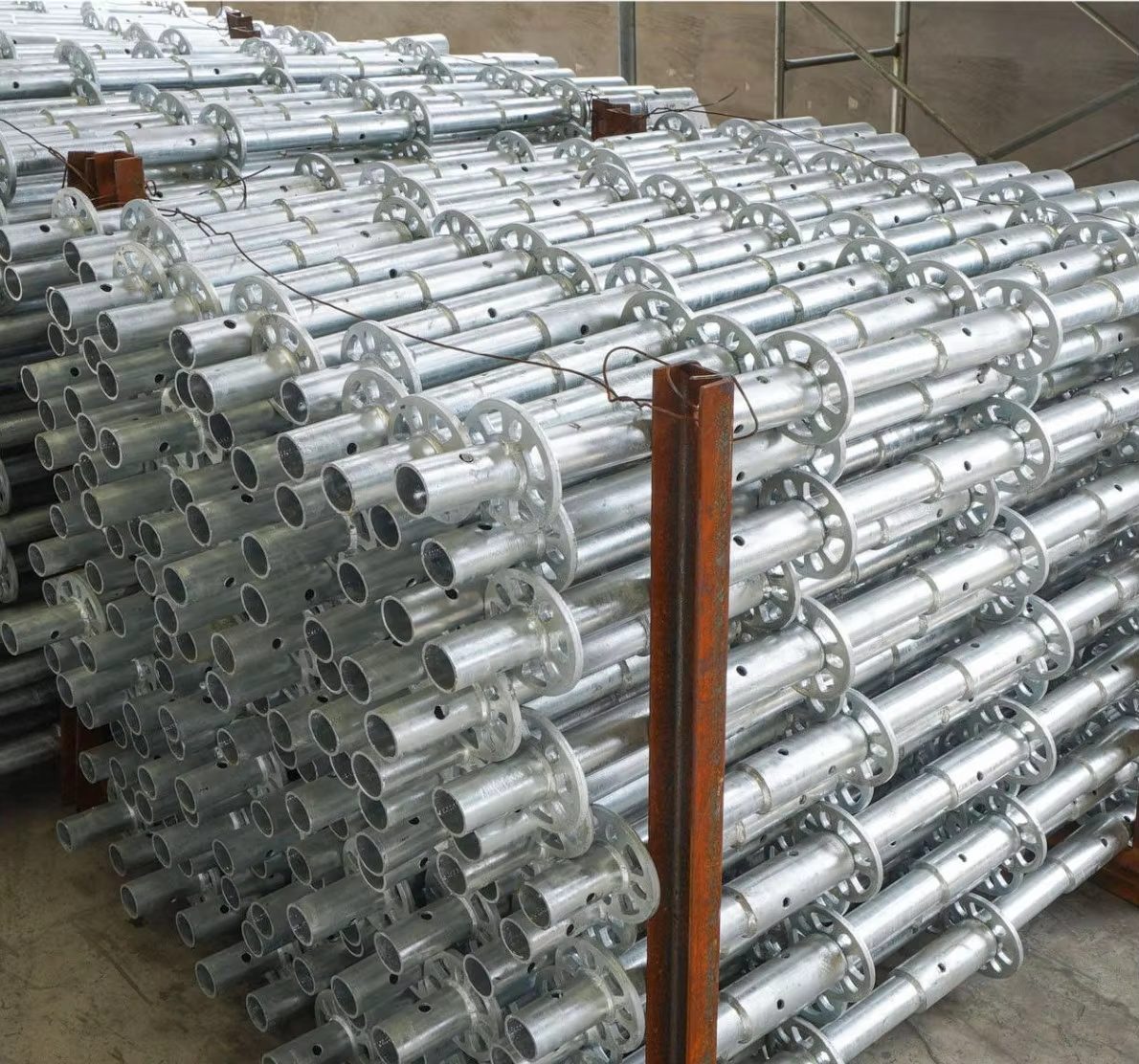
Ringlock standards (verticals) with welded rosettes, hot-dip galvanized and bundled for shipment. Each rosette carries eight connection holes — four large (braces) and four small (ledgers).
Logistics: Moving 20 Containers of Scaffolding to Russia
Twenty 40-foot high-cube containers is not a single-day operation. The shipment was planned and executed in four waves of five containers each, which gave the factory the time to complete production, QC and packaging in a controlled sequence, and gave the customer’s forwarder flexibility with rail and road routing from the port of loading to Moscow.
Packaging and Container Loading
- Bundling: components strapped into uniform bundles with steel banding, length-matched per container plan
- Interlocking: ledger heads nested to maximize density — a well-packed Ringlock container carries noticeably more component mass than a casually packed one
- Protection: each bundle wrapped with stretch film; moisture-absorbing desiccant bags added for the sea leg
- Loading: forklift-loaded to the container plan prepared by our export team, with a photographic record of every container before sealing
- Weight engineering: gross weights balanced across the 20 containers to respect road limits in Russia and rail weight restrictions
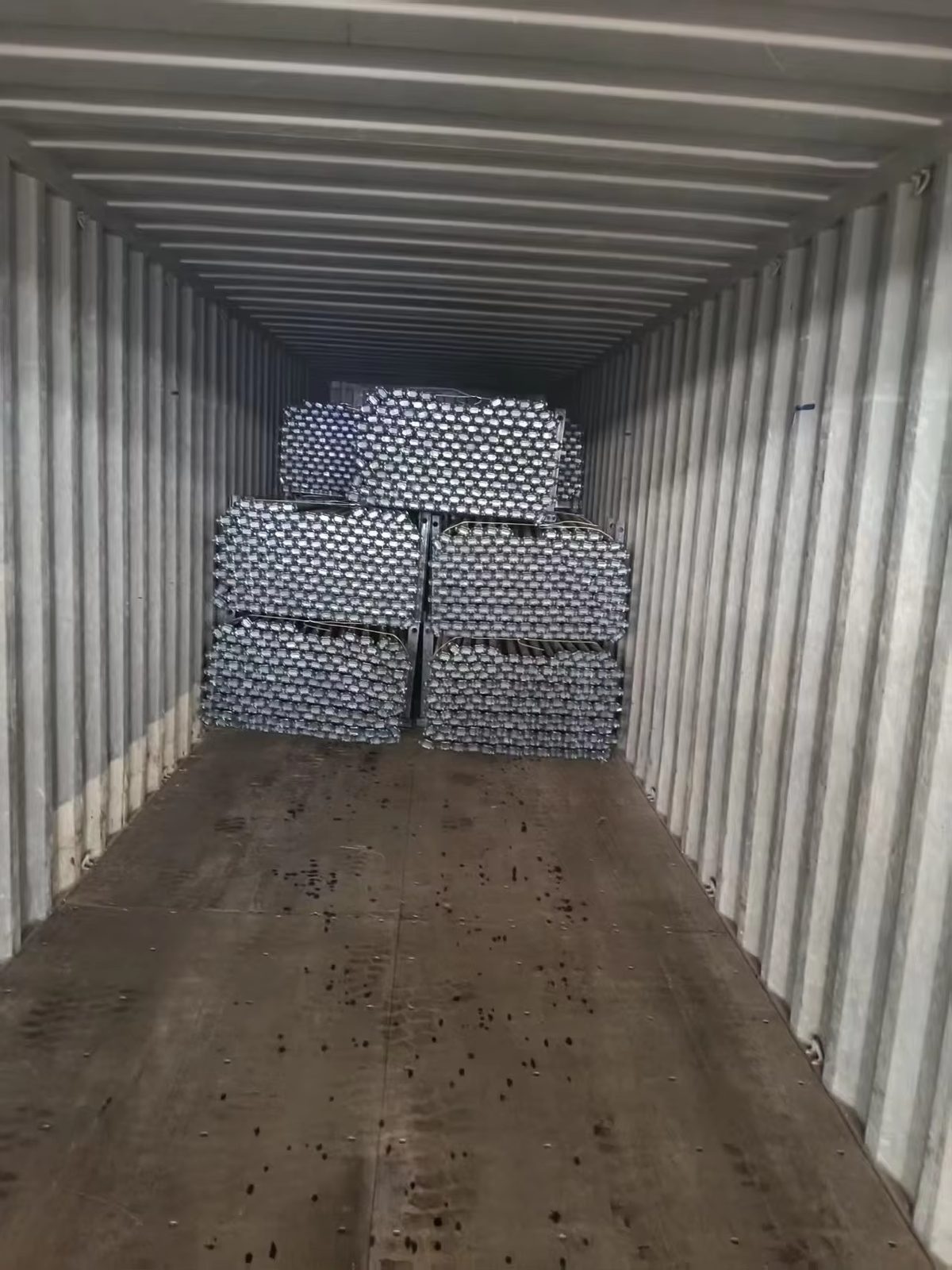
Container loading in progress: galvanized scaffold components bundled, strapped and loaded to the export container plan. Every container is photographed before sealing for the customer’s insurance file.
Roughly 300 metric tons of galvanized steel moved through our yard in that shipping window. For context, that is enough Ringlock system to support the erection of tens of thousands of square meters of façade and access scaffolding across the customer’s active sites, or several high-rise tower cores under construction at once. The customer’s site managers were able to start erecting within days of the first wave arriving — no rework, no missing parts, no field fabrication.
Quality Control Before Shipment
Because the order was sold on system performance, not on per-kilogram price, the QC protocol was written into the contract and followed without shortcuts:
- Material certificates: mill test certificates for every heat of Q355B used, traceable to batch
- Dimensional inspection: 100% check of rosette spacing, tube lengths, and head geometry on sampled lots; wedge function tested on every bundle
- Galvanizing inspection: coating thickness verified with a magnetic thickness gauge at multiple points per batch against the 65–85 µm specification
- Load test documentation: the system’s design load data, based on EN 12810-1 testing, provided for the customer’s engineering approval
- Third-party inspection: offered at customer option (SGS or Bureau Veritas) — the customer elected to rely on our ISO 9001 QC records plus the photographic loading record
Every bundle carried a durable label: item code, length, quantity, and the contract number. When the customer’s warehouse team counted components on arrival, the discrepancies were zero across all 20 containers.
How a 300-Ton Scaffolding Order Actually Gets Decided
If you are a contractor or distributor comparing Ringlock scaffolding manufacturers, here is the decision process we saw — and the questions you should be ready to answer when you ask a supplier for a quote:
- Bay geometry and loads: What bay size (ledger spacing) and lift height do you plan? 1.5 × 1.8 m bays with 2.0 m lifts are the most common starting point for façade work; 1.8 × 2.0 m for heavier industrial access.
- Wind and snow region: In Russia, snow load varies enormously by region (from 0.5 kN/m² in the south to 3.0+ kN/m² in the far north). The brace density and ledger size follow from this — a supplier who quotes without asking your region is quoting a guess.
- Rental vs purchase economics: If the scaffold will be rented out, HDG coating and captive wedges (no lost parts) are the two features that pay for themselves in the first year.
- Compatibility: Is the system compatible with the EN 12810 rosette geometry you already hold from another brand? Rosette dimensions are standardized, but head geometry and wedge profiles differ between manufacturers — confirm physical compatibility, not just paper compatibility.
- Delivery terms: FOB, CIF, or DDP to your yard? For 20-container volumes, DDP to a Russian rail terminal or construction site is often the most predictable option, because it transfers the border and customs risk to the supplier.
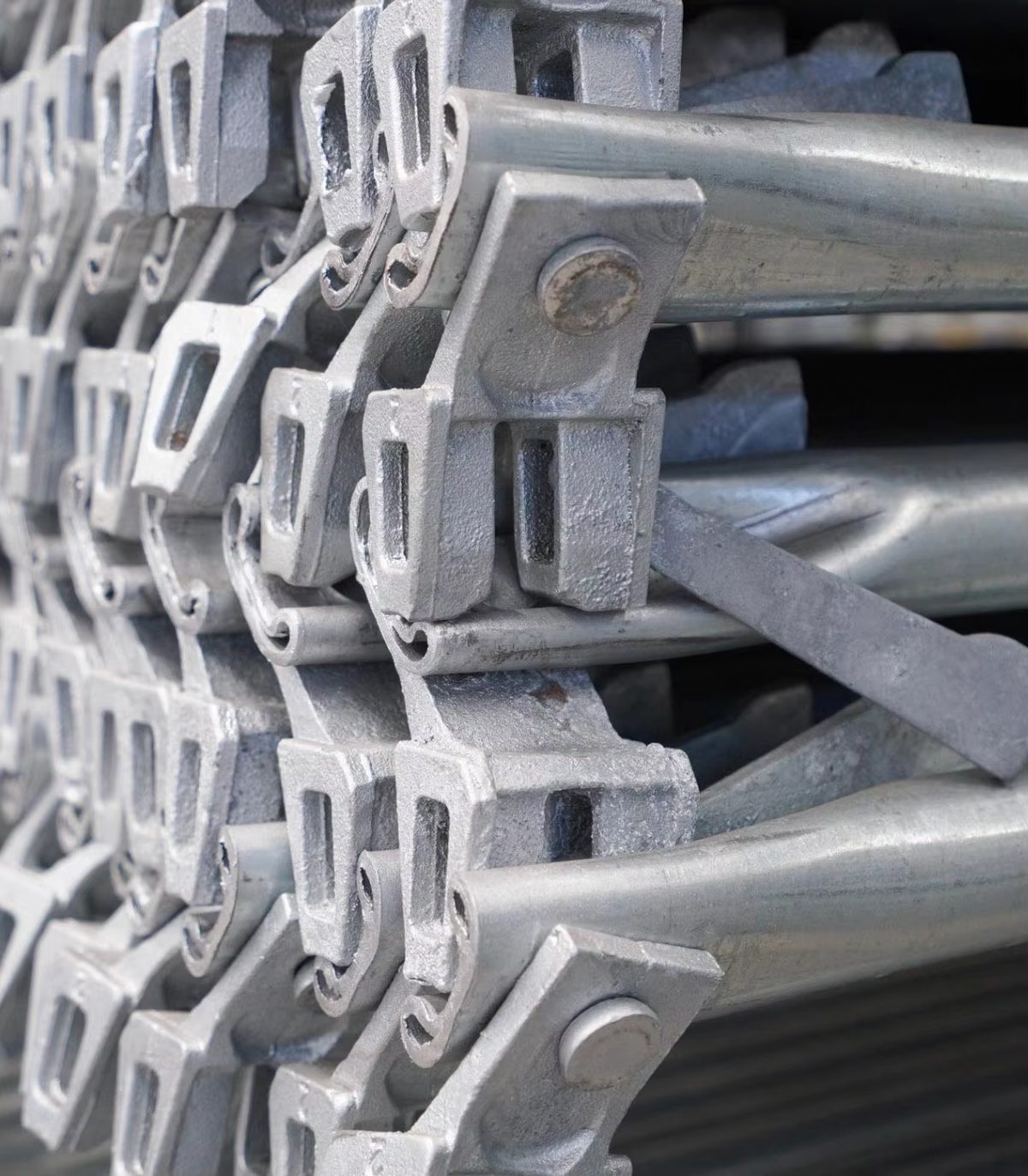
Ringlock ledgers (horizontals): cast heads with captive wedge pins, interlocked for dense packing. The captive wedge is riveted in place — it cannot be lost during transport or erection.
Ringlock Scaffolding Prices: What the Market Actually Pays
The most searched question in this category is “Ringlock scaffolding price” — and the honest answer is that price per kilogram is the wrong metric. System scaffolding is sold on price per square meter of erected scaffold, which depends on the component mix. Here is what moves the number:
- Coating: painted vs hot-dip galvanized — HDG adds cost but is the only rational choice for rental fleets in harsh climates
- Steel grade: Q235B vs Q355B — the higher grade allows lighter sections at the same load, or higher loads at the same weight
- Component density: a lean package (more tubes, fewer fittings) looks cheaper per ton but costs more per m² erected — and vice versa
- Completeness: a real system package includes screw jacks, base plates, tie-in pieces and edge protection — the “accessories” that are 15–25% of a complete order and always left out of headline quotes
- Logistics: freight to Russia from China has swung widely; a fixed-price FOB quote protects you from that volatility, while CIF/DDP shifts it to the supplier
A professional supplier should be able to turn your site plan into a component breakdown with an erected-area figure within one working day. If a quote arrives without a bill of materials and an erected-m² number, treat it as a red flag.
What to Specify When Ordering Ringlock Scaffolding from China
Drawing on this order — and dozens of scaffold and steel export projects before it — here is the specification checklist we recommend every buyer put in writing:
- System and standard: “Ringlock system to EN 12810-1” — written, not assumed
- Steel grade and tube section: e.g. Q355B, Ø48.3 × 3.2 mm
- Coating: HDG to ISO 1461, 65–85 µm, with the measurement method agreed (magnetic gauge, batch sampling rate)
- Component list with lengths and quantities: standards 0.5–3.0 m, ledgers 0.73–2.5 m, braces matched to bay, plus jacks, base plates and tie hardware
- Testing and documentation: mill certificates, load test summary, QC records, packing list per container, photos of loading
- Packaging and loading: bundle weights, strapping, container loading plan, gross weight per container
- Delivery terms and lead time: FOB/CIF/DDP, port or rail terminal, production lead time (for 20 containers, plan 30–45 days from deposit to first loading)
Why Russian Contractors Are Switching to System Scaffolding
The timing of this order was not accidental. The Russian construction market is in the middle of a structural shift that favors exactly what the Ringlock system delivers. Residential construction volumes have stayed high — Moscow alone consistently issues tens of millions of square meters of new residential permits each year — while industrial construction, repair and modernization programs have expanded as import substitution programs push investment into plants, warehouses and logistics hubs. Every one of those projects needs safe access at height, and the access method is changing.
Ten years ago, the default on many Russian sites was still tube-and-coupler scaffolding: cheap to buy, flexible, but brutally labor-intensive to erect and inspect. A 10,000 m² façade scaffold with tube-and-coupler requires thousands of individual couplers, each one a potential failure point and each one tightened by hand. System scaffolding — Ringlock above all — removes that labor and that risk at the same time. With a documented load test behind the system, the site engineer’s inspection is reduced to checking that wedges are driven home, instead of re-verifying thousands of hand-tightened couplers.
There is also a supply-chain dimension. Since 2022, European scaffold systems have become harder and more expensive to source in Russia, while Chinese production — which already supplied a large share of global system scaffolding — has become the default reference for price and availability. Russian contractors and rental companies that previously standardized on European brands are now qualifying Chinese factories directly, and the qualification criteria are exactly the ones this article describes: EN 12810 documentation, ISO 1461 galvanizing, real QC records, and the ability to deliver complete system packages, not just tubes.
For rental companies specifically, the economics are compelling. A Ringlock component set is an asset with a 10–15 year service life if galvanized properly and maintained. The same set can be rented 15–25 times per year. The difference between a cheap painted set that starts rusting in year two and a properly galvanized system that still looks new in year eight is the difference between an asset and a liability — which is why the Moscow customer in this case story specified HDG without negotiation, and why every serious fleet operator we work with does the same.
Inside the Execution: How a 20-Container Scaffolding Order Is Managed
Orders of this size do not happen by email. Here is the actual sequence behind the 20-container shipment, which is also the process you should expect from any professional supplier:
- Day 1–3 — Requirements intake: the customer’s engineering team shared bay geometry, lift heights, load classes, coating requirements and the destination logistics corridor. We translated these into a component bill of materials.
- Day 4–7 — Technical proposal: component breakdown with quantities, an erected-area calculation, the load test summary from our EN 12810-1 documentation, and a commercial offer with payment schedule. The offer stated FOB China and CIF options so the customer could compare freight strategies.
- Day 8–14 — Contract and deposit: contract signed, production deposit received, production slots confirmed in writing, and the sample approval step agreed (reference samples photographed and dimensionally recorded against the spec).
- Week 3–7 — Production and QC: steel released from the mill with certificates, tube cut and welded, rosettes welded and inspected, HDG applied in batches, coating thickness verified, and load function tested per bundle. Weekly progress reports with photos were sent to the customer.
- Week 7–9 — Packaging and loading waves: components bundled, strapped and wrapped, then loaded into the 20 containers in four waves of five. Each container was weighed, photographed and sealed, with a packing list per container.
- Week 9+ — Shipping and handover: documents (invoice, packing list, bill of lading, certificates) issued per wave; the customer’s forwarder handled customs and onward delivery to Moscow, with our team on call for any documentation question.
The lesson from this sequence: a serious order is managed like a small project, not a purchase. If a supplier cannot show you a production calendar, a QC plan and a loading plan in writing, you are not buying system scaffolding — you are buying hope.
Five Mistakes to Avoid When Buying Ringlock Scaffolding from China
Having shipped hundreds of containers of steel products to dozens of countries, we see the same five mistakes from buyers again and again. Avoid them and your first order will go as smoothly as the Moscow project did:
- Buying on per-ton price only. The cheapest quote is usually the one missing the accessories — jacks, base plates, tie hardware, edge protection — that turn a pile of tubes into a usable system. Compare complete bills of materials and erected-area prices, not tonnage rates.
- Ignoring the galvanizing spec. “Galvanized” means nothing without a coating thickness and a standard. HDG to ISO 1461 at 65–85 µm is the reference; anything electro-galvanized or thinly coated will fail in Russian winters and void your fleet economics.
- Not verifying physical compatibility. Paper compatibility (same rosette pitch) is not the same as physical compatibility (head and wedge geometry). If you are adding to an existing fleet, request physical sample heads before committing.
- Skipping documentation requirements. Russian customs and site supervision will ask for certificates and conformity documents. Confirm in the contract which documents the supplier provides and which your customs broker will prepare — and get the list in writing before the deposit.
- Underestimating lead time and freight volatility. A 20-container program needs 30–45 days of production plus a shipping window that can stretch in peak season. Book production slots early, and prefer fixed-price FOB terms so freight swings do not reopen your budget after the contract is signed.
Care and Maintenance: Protecting Your Ringlock Investment
Ringlock is built to be reused for a decade or more, but only with basic discipline. The maintenance protocol we recommend to every fleet owner is short enough to print and post in the yard:
- After every rental cycle: knock off concrete and mortar, visually inspect wedges and heads, and replace any head with a bent wedge or cracked casting immediately — never field-repair cast heads
- Annual: check coating on high-wear areas (head pockets, rosette slots); touch up only with a zinc-rich paint compatible with HDG; re-measure coating thickness on a sample of components
- Storage: keep components off bare ground (pallets or gravel), allow drainage, and stack by length to avoid sorting costs on the next dispatch
- Documentation: keep load test certificates and the manufacturer’s erection instructions with the fleet — Russian site inspectors increasingly ask for system documentation, and having it on hand turns an inspection into a formality
Follow that routine, and a properly galvanized Ringlock fleet will outlast the projects it was bought for — which is exactly why the Moscow contractor ordered HDG as a specification, not an option.
Frequently Asked Questions About Ringlock Scaffolding
Q1. What is Ringlock scaffolding?
Ringlock (also written Ring Lock) is a modular system scaffold in which horizontal ledgers and diagonal braces lock onto eight-hole rosettes welded to the vertical standards. A wedge pin on each ledger head is driven into the rosette with one hammer blow, creating a positive, self-locking connection. It is one of the most widely used systems for high-rise construction, industrial access and formwork support in Europe, the Middle East and Russia.
Q2. Ringlock vs Cuplock — which is better?
Ringlock allows up to eight connections per node (four ledgers + four braces) versus four on Cuplock, and is generally preferred for high-rise and heavy industrial work where brace density and load capacity matter most. Cuplock is cheaper per component and remains strong for general construction and shoring. For rental fleets and multi-site contractors, Ringlock’s faster erection usually wins on total cost.
Q3. What load can Ringlock scaffolding carry?
Design loads are established by testing to EN 12810-1 and depend on bay size, lift height and component grade. Typical working load classes for façade systems are 2.0–6.0 kN/m² (Class 2–6); with Q355B standards and 1.5 × 1.8 m bays, many systems are designed to the upper end of that range. Always request the load tables from your supplier — never rely on a verbal “heavy duty” claim.
Q4. What are the standard dimensions of Ringlock scaffolding?
Standards are commonly 0.5–3.0 m with rosettes every 500 mm; ledgers run 0.73–2.5 m; braces match bay sizes. Tube is typically Ø48.3 × 3.2 mm (EN 39 compatible), with Ø60.3 mm heavy-duty options for formwork support.
Q5. Is Ringlock scaffolding compatible with other brands?
Rosette geometry is broadly standardized, so components from different manufacturers often fit — but head profiles and wedge shapes differ, and mixing brands can compromise the engineered safety of the system. For permanent fleets, we recommend single-source supply; for incremental additions, request a physical fit test before mixing.
Q6. What is the price of Ringlock scaffolding?
Prices are quoted per component set or per erected square meter, and vary with steel grade, galvanizing thickness, component density and freight. HDG Ringlock from Chinese factories is typically the most competitive source globally, but the cheapest per-ton quote is rarely the cheapest per-m²-erected. Ask for a complete bill of materials, not a headline tonnage price.
Q7. How long does a large Ringlock order take to produce and ship?
For volumes like 20 containers (300+ tons), allow 30–45 days from deposit to first container loading, plus 20–35 days sea freight to Russian ports (Vladivostok, St. Petersburg or Novorossiysk depending on origin), or rail transit via Kazakhstan. Your supplier’s production calendar should be confirmed in writing before you place the deposit.
Q8. Why is hot-dip galvanizing important for scaffolding in Russia?
Russian construction climates combine severe freeze-thaw cycles, heavy snow and long wet seasons. HDG to ISO 1461 (65–85 µm) protects steel for years of outdoor use, rental rotation and repeated handling, eliminating field touch-up and premature rust replacement. Painted scaffold is a false economy on any multi-year project.
Q9. Can Ringlock scaffolding be used as formwork support (falsework)?
Yes — with Ø60.3 mm heavy-duty standards, denser bay layouts and proper base jacks, Ringlock is widely used for slab and beam formwork support with loads far above façade applications. Specify the shoring configuration (loads, slab thickness, story height) and the supplier will engineer the layout.
Q10. What documents should a Ringlock supplier provide?
At minimum: mill test certificates, ISO 9001 certificate, EN 12810-1 load test summary, QC inspection records, detailed packing lists per container, and loading photos. For Russian customs and Gosstroynadzor processes, your supplier should also be able to supply the documentation needed for conformity assessment (ГОСТ / ЕАЭС as applicable).
Choosing Delivery Terms: FOB, CIF or DDP for Russia
Delivery terms are where scaffolding orders quietly go wrong. The three most common choices for China-to-Russia shipments each shift risk differently, and the right answer depends on your in-house logistics capability:
- FOB (named port) — you take over at the port of loading: you book freight, insurance and customs, and you carry the freight-cost risk. This suits importers with established forwarding arrangements and, in volatile freight markets, protects your budget from supplier-side markup on shipping.
- CIF (named port of destination) — the supplier pays for freight and insurance to the destination port (typically Vladivostok, St. Petersburg or Novorossiysk). You handle port handling, customs and inland delivery. A good middle ground for first orders: one fixed price, predictable to the port.
- DDP (named place of destination) — the supplier handles everything through to your yard or site, including customs clearance. Maximum predictability for the buyer, and the supplier carries the border risk. For 20-container programs, DDP to a rail terminal or construction site is often the cleanest option because it consolidates all documentation work on one side of the table.
Whichever term you choose, put the split of responsibilities in the contract: who clears customs, who holds the conformity documents, and who owns the goods at each handover point. Ambiguity here is the most common source of delayed scaffold deliveries in Russia — and delayed scaffold means a stopped site, which costs far more than the freight was ever worth.
Working with Sino East Steel Group on Your Next Scaffolding Order
This 20-container project is one data point among many: Sino East Steel Group supplies Ringlock system scaffolding, galvanized scaffold tube, scaffold fittings and related steel products to contractors and distributors across Russia, the CIS and beyond — with hot-dip galvanizing, ISO 9001 quality control, and export packaging engineered for container and rail transport.
If you are planning a scaffolding procurement — whether it is one trial container or a 20-container program — the fastest way to start is to send us your site requirements: bay geometry, lift heights, load class, coating preference and destination port. We will return a component breakdown, an erected-area figure and a commercial offer within one working day. You can reach us through our contact page or directly on WhatsApp: +86 186 2208 8833.
For more background on sourcing scaffold systems from China, see our guide: How to Choose a Scaffolding Supplier in China.
Pingback: 20 контейнеров кольцевых лесов Ringlock отправлено в Росси