How Much Does Scaffolding Cost? Price per Tonne, Quantity Calculation and Specification (2026)
Scaffolding cost is not one number — and that is why two quotes for the same façade can differ by 30%. Ask ten suppliers for a scaffolding price and you will get ten different numbers — not because nine of them are cheating you, but because “the price of scaffolding” is not one number. It is the result of six variables: system type, steel weight per square metre of façade, package completeness, galvanizing class, container fill and delivery terms. Two quotes that look comparable at USD per tonne can differ by 30% in the cost per square metre of façade actually handed over on site.
This guide shows how scaffolding cost is built up in 2026: the market benchmarks we can verify, the weight-per-m² figures that convert a façade area into tonnage, a complete worked example for a 1,200 m² building, the buy-versus-rent break-even calculation, and the duty and VAT treatment when the package is imported into the EAEU. At the end there is a specification template — fill it in and our export desk returns a package calculation and price within 24 hours.
What actually drives scaffolding cost
Before comparing quotations, it helps to know which of the six levers you are moving. Every one of them changes the final number, and four of them are invisible on a price-per-tonne comparison.
| Cost driver | What changes | Typical effect on cost per m² of façade |
|---|---|---|
| 1. System type | Frame, cuplock, ringlock, tube-and-clamp | Ringlock is 15–30% more expensive per tonne than frame and cuplock; the gap is partly recovered through faster erection |
| 2. Steel weight per m² | Bay width, lift height, deck width, load class | The single largest multiplier: a heavy-duty package can hold 40% more steel than a light façade package for the same façade area |
| 3. Package completeness | Standards, ledgers, transoms, diagonals, boards, base jacks, wall ties, toe boards, access ladders | Missing accessories bought later cost more than the same items bought with the package — and they stop erection on site |
| 4. Galvanizing class | Hot-dip galvanizing per EN ISO 1461 vs pre-galvanized or painted tube | HDG at 65–85 µm (450–600 g/m²) costs more per tonne but delivers 10–15 years of outdoor service; thin coatings fail in 2–3 seasons and re-buy the package |
| 5. Container fill | How much tonnage actually fits in the 40HC you pay for | A package that fills 1.6 containers pays for two full containers; a package that fills 1.9 containers pays the same freight for 19% more steel |
| 6. Delivery term and clearance | EXW, FOB, CIF, DAP; duty and VAT | Import duty of 7.5% plus VAT of 22% is applied on top of the customs value, so the term you buy on changes the landed cost by roughly a third |
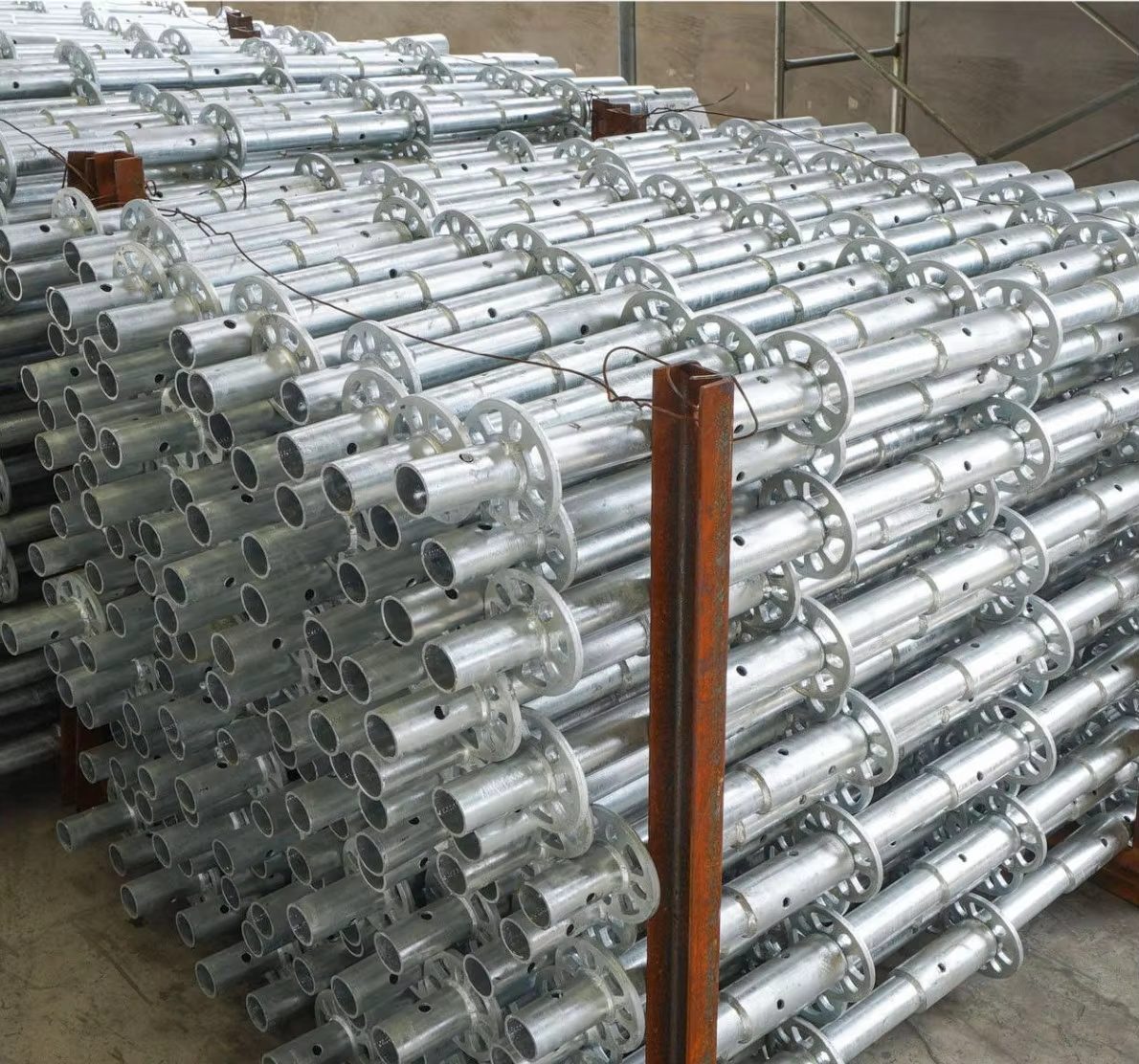
Ringlock standards with welded rosette discs (eight holes per rosette, welded at 500 mm pitch) in banded bundles before loading. Rosette spacing and weld quality — not the paint colour — determine what the package will carry.
Market price benchmarks for 2026
Scaffolding is sold by weight, so the market reference is USD per tonne. Public sources in September 2026 put the export band from China like this:
| Reference | Figure | Source and date |
|---|---|---|
| Price band for ring scaffolding sold by weight or in sets | USD 500–1,100 per tonne, depending on system and configuration | Accio market research on China ring scaffolding, 10 September 2026 |
| Marketplace listings for ringlock scaffolding, factory direct | USD 800–1,400 per tonne at a 20-tonne MOQ | Made-in-China ringlock scaffolding price listings, September 2026 |
| Historic peak export price for scaffolding, shuttering and propping equipment from China | USD 2,039 per tonne (peak level) | IndexBox China market overview, July 2025 |
Three things follow from these numbers. First, a wide band is normal: the same nominal system can be sold at 8 kg/m² of lighter tube or at 12 kg/m² with proper rosettes and forged locks, and the two are not the same product. Second, the per-tonne price is only half the story — the tonnage needed for your façade is set by the weight per m² figures in the next section. Third, the reference price excludes freight, duty and VAT, which together can add 30–40% to the FOB figure.
What rental costs in Moscow today
For Russian contractors comparing buying against renting, current Moscow rental rates published by rental operators are useful as a reference point: frame scaffolding from 75 RUB per m² per month (about 2.5 RUB per m² per day), cuplock (wedge) scaffolding from 135 RUB per m² per month (about 4.5 RUB per m² per day), and tube-and-clamp scaffolding from 120 RUB per m² per month (about 4.0 RUB per m² per day). Rental companies also take a refundable deposit — around 200 RUB per m² for new equipment and 150 RUB per m² for used. These rates are per m² of scaffold per day, not per m² of building, and they exclude erection, dismantling and transport.
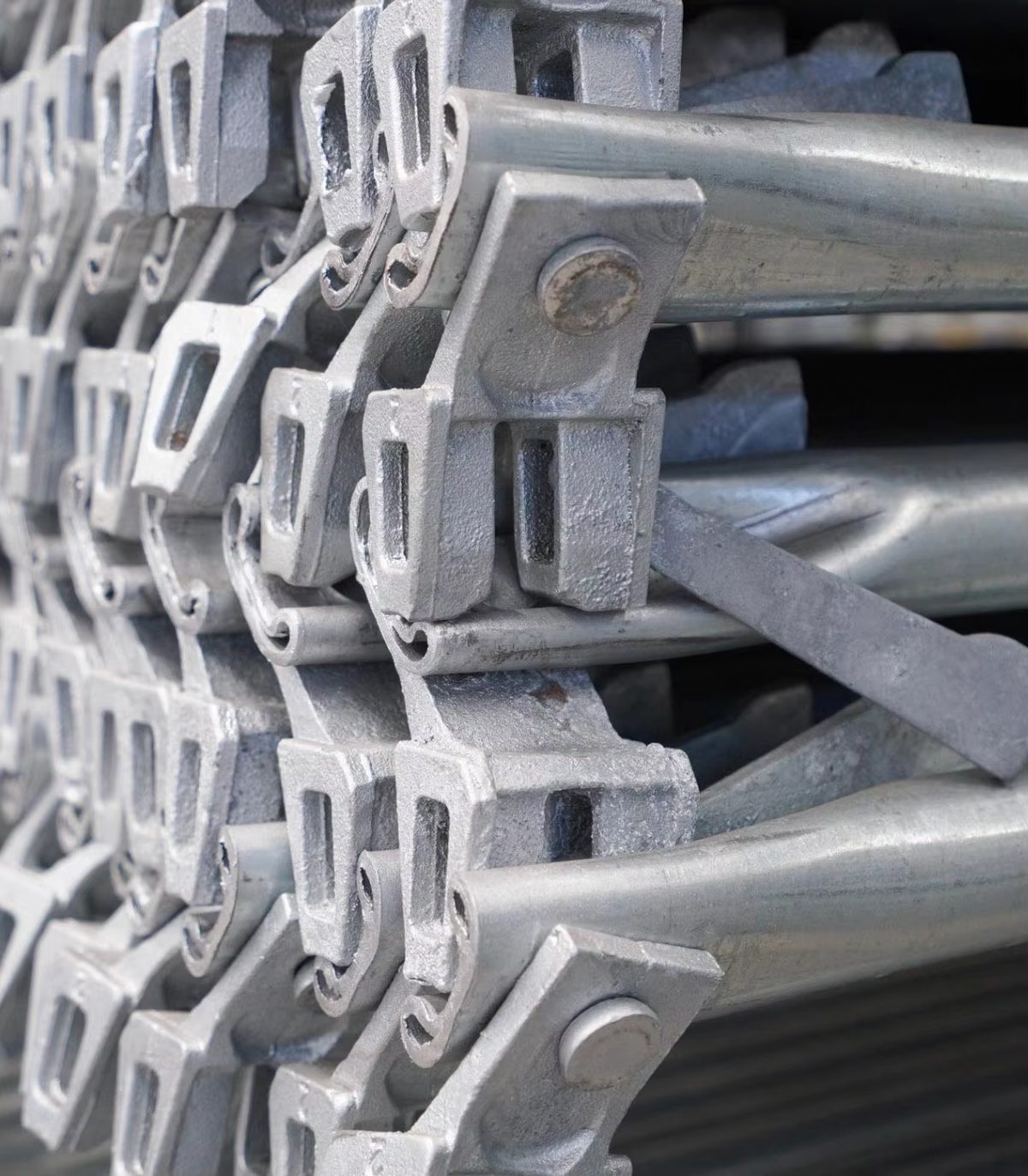
Ledgers with forged end locks. The lock is the part that fails first on cheap copies — ask for the mill’s node test report, not a photograph.
Steel weight per m²: the number that decides your tonnage
Scaffolding cost is driven less by the price per tonne than by how many tonnes your façade needs. Published engineering guidance puts a complete steel frame (H-frame) scaffold at roughly 19–21 kg per m² of scaffolded area, and a modular system scaffold at roughly 24 kg per m² (Cetrac, scaffolding weight and transport guide). That 4 kg difference looks small until it is multiplied across a real building.
| Parameter | Frame scaffolding | Modular (ringlock / cuplock) |
|---|---|---|
| Steel weight per m² of scaffolded area | ≈ 19–21 kg/m² | ≈ 24 kg/m² |
| Working load on the platform | 150–200 kg/m² | Up to 300 kg/m² (cuplock), up to 400 kg/m² and above (ringlock) |
| Erection speed, 100 m² per crew of four | 1.5–2 days | ≈ 1 day |
| Practical working height | Up to 30 m | Up to 40–60 m, and 60 m+ for ringlock |
The formula the calculation always comes back to is short:
Tonnage = façade area (m²) × steel weight per m² (kg/m²) ÷ 1,000
Everything else — price, container count, freight, duty — is derived from that tonnage. This is also why a request for “the price of scaffolding for a 5,000 m² building” cannot be answered with a single number: the same 5,000 m² is 95 tonnes in frame scaffolding and 120 tonnes in a modular system with heavy-duty decks.
Worked example: a 1,200 m² façade from package to landed cost
Take a real project profile: a residential block with a 60 m long façade and a 20 m working height — 1,200 m² of scaffolding. We will run both a frame package and a modular package through the same six steps, using the published figures above and a clearly stated assumption for the FOB price.
Assumptions: FOB China USD 700 per tonne (inside the USD 500–1,100 band cited above, chosen for a hot-dip galvanized package with mill test certificates); sea freight Shanghai to St. Petersburg USD 3,100–4,323 per 40ft container (published China–Russia container rate reference, October 2025, the most recent dated figure available); import duty 7.5% under TN VED 7308 40 000 9; VAT 22% in force in Russia from 1 January 2026 (Federal Law No. 425-FZ of 28 November 2025). Container capacity is taken as 15 tonnes of bundled scaffolding per 40HC — the figure from our own 20-container Ringlock shipment to a Moscow contractor, where 300+ tonnes travelled in 20 × 40HC.
| Step | Frame package | Modular package |
|---|---|---|
| 1. Scaffolding area | 1,200 m² | 1,200 m² |
| 2. Steel weight per m² | 20 kg/m² (mid of 19–21) | 24 kg/m² |
| 3. Total tonnage | 24.0 t | 28.8 t |
| 4. FOB value at USD 700/t | USD 16,800 | USD 20,160 |
| 5. Containers (15 t per 40HC) | 1.6 → 2 × 40HC | 1.92 → 2 × 40HC |
| 6. Sea freight, 2 × 40HC | USD 6,200–8,646 | USD 6,200–8,646 |
| 7. CIF customs value | USD 23,000–25,446 | USD 26,360–28,806 |
| 8. Import duty 7.5% | USD 1,725–1,908 | USD 1,977–2,160 |
| 9. VAT 22% on (CIF + duty) | USD 5,440–6,018 | USD 6,234–6,813 |
| 10. Landed cost including VAT | USD 30,165–33,372 | USD 34,571–37,779 |
| 11. Cost per m² of façade | USD 25–28 / m² | USD 29–31 / m² |
Read the last line carefully, because it contains the commercial point of this whole guide: the modular system is 15–30% more expensive per tonne, but on a per-m²-of-façade basis the difference is USD 25–28 against USD 29–31 — roughly 15%. The rest of the per-tonne gap is absorbed by the fact that both packages occupy the same two containers, so freight, duty and VAT are paid on a smaller relative base in the frame case. Freight and clearance do not scale with the tonnage alone; they scale with the number of containers you have to pay for.
Two further notes on this arithmetic. First, import VAT is normally recoverable for a VAT-registered Russian importer, so the effective comparison for a company that resells or offsets VAT is the pre-VAT figure: USD 24,725–27,354 for the frame package and USD 28,337–30,966 for the modular package. Second, the duty rate must be checked against the actual goods: TN VED 7308 40 000 9 covers equipment for metal scaffolding, shuttering, propping or pit-propping, and separate parts such as couplers may be classified differently.
Buy or rent: the break-even calculation
For a contractor or a rental operator, the buy-versus-rent decision comes down to one question: how many days will the fleet actually be on site and earning? The comparison below uses the landed costs from the table above and the current Moscow rental reference rates, converted at 84 RUB per USD (Bank of Russia official rate, mid-September 2026 — treat the exchange rate as an input, since it moves).
| Scenario | Purchase, landed, per m² of façade | Rental reference, per m² per day | Break-even use |
|---|---|---|---|
| Frame scaffolding | USD 25–28 / m² = 2,112–2,336 RUB / m² | 2.5 RUB / m² / day | ≈ 845–935 rental days (roughly 2.3–2.6 years of continuous use) |
| Modular (cuplock / ringlock) | USD 29–31 / m² = 2,420–2,645 RUB / m² | 4.5 RUB / m² / day | ≈ 540–590 rental days (roughly 1.5–1.6 years of continuous use) |
Three qualifications matter here. Rental rates are quoted for the scaffold area in place and exclude erection, dismantling, transport and any lost or damaged components, all of which the owner pays when buying but the renter pays separately. The deposit of 150–200 RUB per m² is refundable, so it affects cash flow rather than cost. And a purchase has a residual value: hot-dip galvanized modular scaffolding that is correctly stored and maintained has a service life measured in a decade or more, so the break-even is a floor, not a ceiling — after it, the marginal cost of the fleet is maintenance.
Practical rule we give to customers: one project under about 600 rental days — rent. Continuous façade programmes, a rental business, or more than two years of expected use — buy, and buy the system that will still be supported by spare parts in five years. Our scaffolding supplier guide covers how rental companies and contractors evaluate the supplier side of that decision.
Indicative component take-off for the 1,200 m² example
Once the tonnage and the system are fixed, the package is a take-off problem. For the same 60 m × 20 m façade in a ringlock package we assume a 3.0 m bay along the façade, a 1.5 m deck width, a 2.0 m lift and a scaffold height of 21 m (20 m working height plus one guard-rail level), built from 3 m standards. On those assumptions the main items come out as follows.
| Item | Rule used | Indicative quantity |
|---|---|---|
| Standards, 3.0 m | 21 vertical lines (60 m ÷ 3.0 m + 1) × 2 rows × 7 standards per line for 21 m height | ≈ 290 pcs |
| Ledgers, 3.0 m (longitudinal) | 20 bays × 2 rows = 40 per level × 11 ledger levels | ≈ 440 pcs |
| Transoms, 1.5 m | 21 positions × 11 ledger levels | ≈ 230 pcs |
| Steel platform boards, 3.0 m × 0.32 m | 4 boards per bay to build a 1.5 m deck × 20 bays × 10 platform levels | ≈ 800 pcs |
| Base jacks (adjustable) | One per vertical line, to level the base on uneven ground | ≈ 42 pcs |
| Diagonal bracing, wall ties, toe boards, access ladders | Per the bracing plan and the anchoring scheme for the actual building | Issued with the factory package drawing |
These quantities are indicative and are shown so you can see how the arithmetic works — the binding list is the one issued with the factory package drawing, because bracing layout, anchoring pattern and building geometry change the accessory count. What the take-off does show is where the money sits: on a ringlock façade package the ledgers and the platform boards together usually account for more pieces than the standards, which is why “how many tonnes of standards do I need” is the wrong first question.
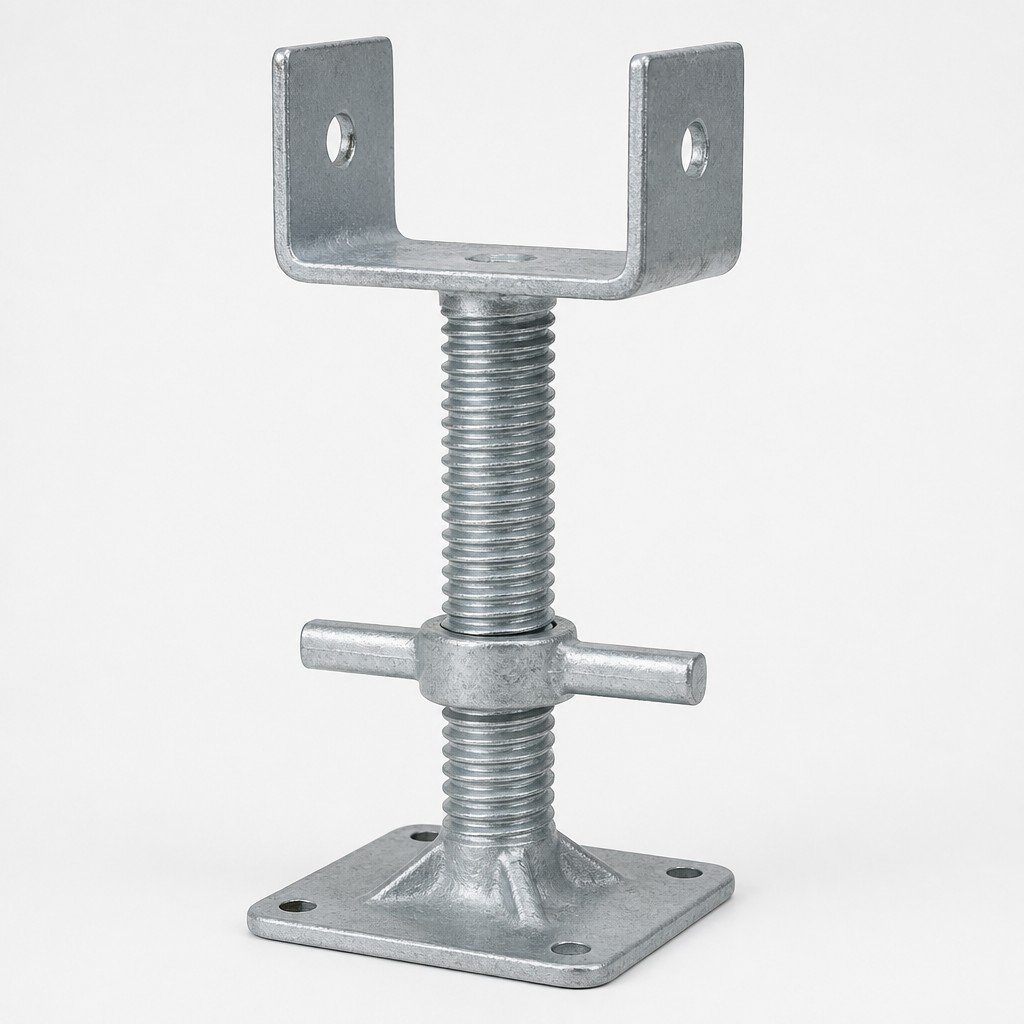
Adjustable base jack with U-head. Base jacks and wall ties are the two accessories buyers most often leave out of the first enquiry — and the two that stop erection fastest.
Seven ways to reduce scaffolding cost without losing quality
- Buy the system the project needs, not the one the catalogue sells. For a flat façade under 30 m with loads below 200 kg/m², frame scaffolding delivers the same working face for roughly 15% less per m² of façade. Moving to a modular system only pays when loads, geometry or height demand it, or when the same package will be reused across sites.
- Match galvanizing to service life, not to appearance. For outdoor use in Russia and the CIS, hot-dip galvanizing per EN ISO 1461 at 65–85 µm (450–600 g/m²) is the specification that survives 10–15 years. Coatings at 300–400 g/m² are cheaper and corrode within 2–3 outdoor seasons — the second purchase costs more than the first saved.
- Fix the bay and lift module before pricing. Bay width and lift height set the steel quantity. Increasing the lift from 2.0 m to 2.5 m reduces the number of ledger levels, but it also reduces load capacity and needs recalculation; very often the cheaper answer is to keep the 2.0 m lift and reduce the deck width on non-working levels.
- Compare quotes on cost per m² of façade, on the same Incoterm. A FOB number and a DAP number are not comparable, and a per-tonne number hides the tonnage.
- Fill the container. At 15 tonnes of bundled scaffolding per 40HC, a package of 24 tonnes leaves 1.6 containers’ worth of freight to be paid on half-empty space. Adding accessories, spare parts or the next phase of the fleet to the same shipment costs almost nothing in freight terms. Our 20-container Ringlock case study shows how a multi-site order was consolidated this way.
- Declare the customs position before ordering, not after. Duty at 7.5% under TN VED 7308 40 000 9 and VAT at 22% are applied to the customs value, so an incorrect classification or a missing certificate of origin is an expensive correction. Prepare the HS code, the EAC documentation and the origin certificate with the supplier while production runs.
- Buy the spares with the package. Couplers, wedge heads, rosette locks and base jack spindles are the parts that wear. Ordered separately later, they carry the same freight, duty and clearance cost as the main shipment but on a fraction of the volume.
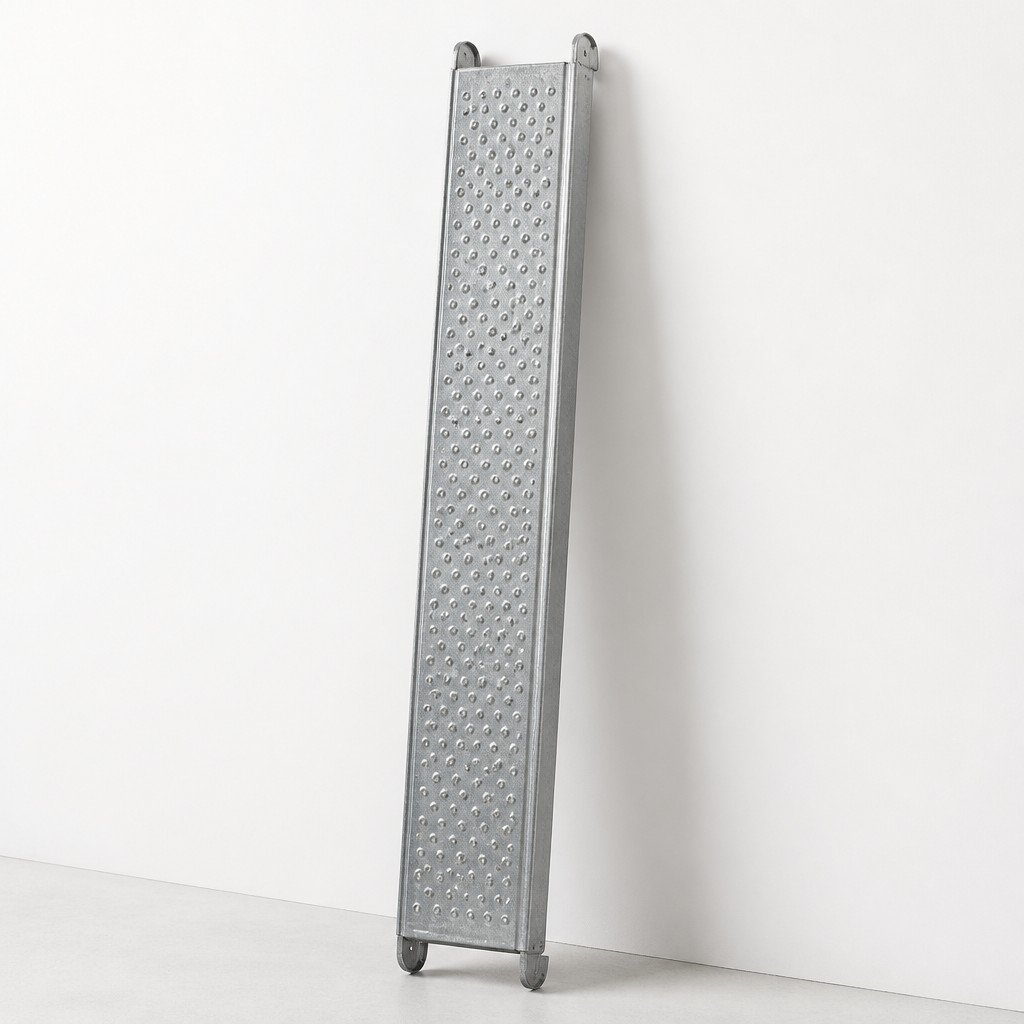
Galvanized perforated platform board with end hooks. Boards and ledgers dominate the piece count in a façade package, which is why the deck specification changes the price more than the standard does.
Container loading, documentation and standards
Scaffolding is dense, heavy and awkward to stack, so loading quality directly changes your landed cost. Bundled and strapped packages travel better than loose components, arrive without deformation in the tubes and keep the galvanizing intact. In our own shipments we work to around 15 tonnes of bundled scaffolding per 40HC; that figure comes from a shipment of 300+ tonnes in 20 × 40HC to a Moscow contractor, and it is the number to use when you sanity-check a supplier’s container plan.
Production of a standard scaffolding package runs 20–30 days after specification approval; sea freight to St. Petersburg or Novorossiysk takes 35–45 days, and the full multi-site Ringlock order mentioned above took 45 days from specification to loading. The documentation that should travel with the goods is:
- Mill test certificates per EN 10204 3.1 for tubes, standards and ledgers;
- Galvanizing documentation per EN ISO 1461 with coating weight per batch;
- Load test and node test reports for the system (EN 12811-1 / EN 12810-1);
- Product passports and system drawings, plus the bracing and anchoring plan;
- EAC declaration or certificate for the EAEU market where the technical regulations apply;
- Packing list designed to match the package drawing, so you can check the delivery against it item by item.
On standards, three references decide whether the package will pass inspection: EN 12810-1 for system scaffolding and EN 12811-1 for working scaffolds and their load classes, which define working loads from load class 1 at 0.75 kN/m² up to load class 6 at 6.0 kN/m² (roughly 75 to 600 kg/m² uniformly distributed); GOST 27321-87 for frame and pin scaffolding on the Russian market; and EN 10219 for the cold-formed structural hollow sections, which is where the 48.3 mm outer diameter with 3.2–4.0 mm wall on scaffolding tube comes from. The practical consequence of the load classes is simple: if the platform will carry pallets of brick, mortar tubs or heavy tools, the calculation must sit in class 4 or above, and a light façade package will not pass.
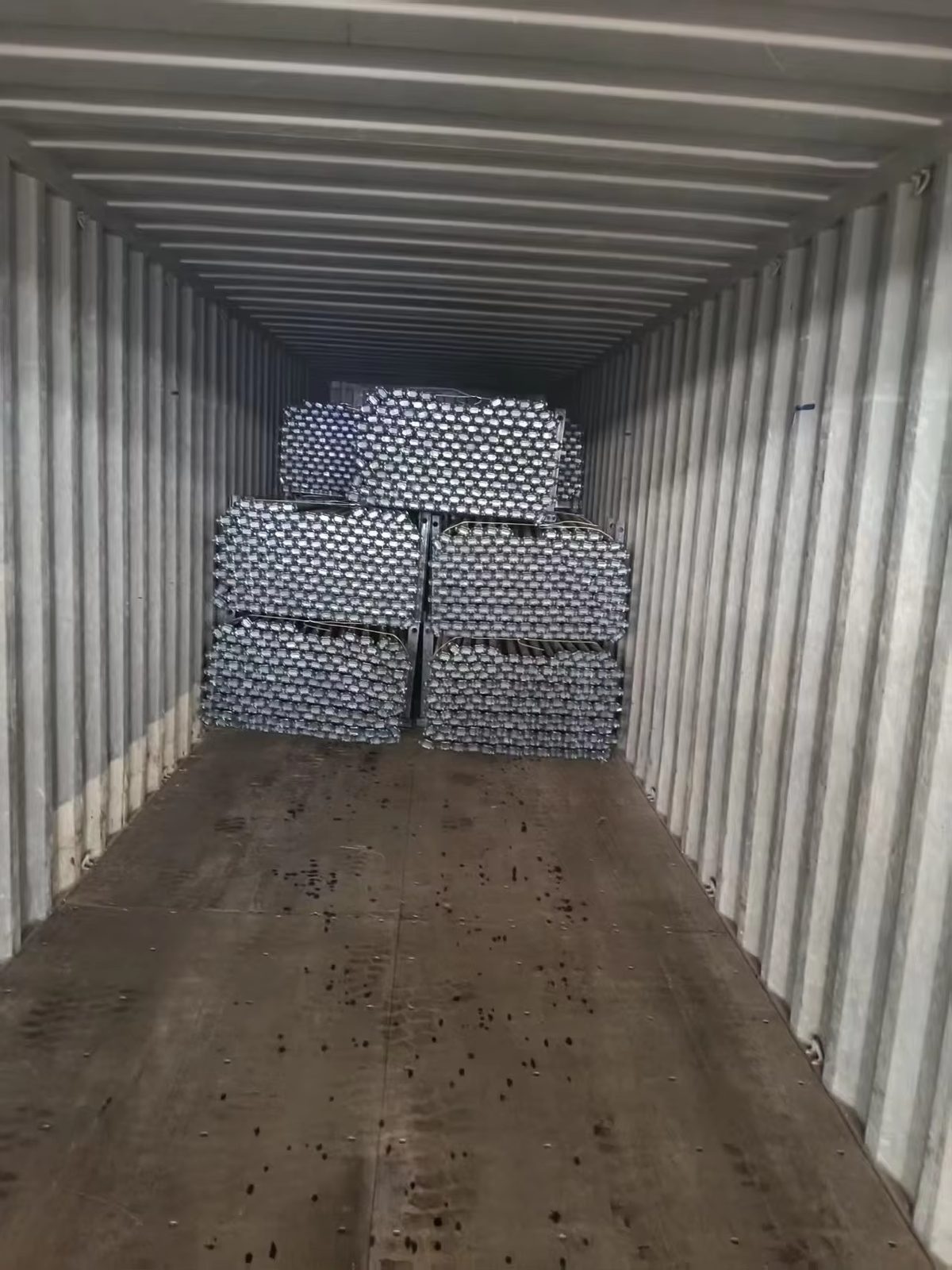
Bundled scaffolding components in a 40HC container. Bundling and strapping protect the galvanizing in transit, and a well-planned load is worth several tonnes of freight per container.
Specification template: send this and get an exact price in 24 hours
Most scaffolding quotations take a week because the enquiry was incomplete. Completing the table below typically removes two rounds of questions and gets you a firm package price the same or next day.
| Field | What to specify | Example |
|---|---|---|
| System | Frame, cuplock, ringlock or tube-and-clamp | Ringlock |
| Application | Façade, shoring, industrial, event, tower | Façade, brickwork |
| Façade length × working height | Metres, and total area if known | 60 m × 20 m = 1,200 m² |
| Required load class | EN 12811-1 class, or the materials to be handled | Class 4 (300 kg/m²) |
| Bay and lift module | If the project dictates it | 3.0 m bay, 2.0 m lift |
| Deck width | 0.32 m boards per bay, total deck | 1.5 m |
| Galvanizing | HDG per EN ISO 1461 with target coating weight | 65–85 µm, 450–600 g/m² |
| Accessories | Base jacks, wall ties, toe boards, ladders, spares | Included |
| Documentation | MTC 3.1, load test reports, EAC | Included |
| Incoterm and destination | FOB, CIF or DAP, port or city | CIF St. Petersburg |
| Quantity | Sets, m² of façade or tonnes | 1,200 m² |
| Timing | Required delivery, and whether the order is phased | Q1 2027, one shipment |
Six mistakes that make scaffolding more expensive
- Comparing price per tonne instead of cost per m² of façade. The per-tonne price is the input; the m² figure is what the project pays.
- Leaving accessories out of the first enquiry. Base jacks, wall ties and toe boards then arrive as a second shipment, carrying freight, duty and VAT on their own account — and stopping erection in the meantime.
- Specifying galvanizing by description instead of by coating weight. “Galvanized” without a g/m² figure is an invitation to a 300 g/m² coating.
- Assuming Chinese scaffolding cannot be certified for Russia. Export mills manufacture to GOST 27321-87 (frame, pin) or EN 12810-1 (system scaffolding) with MTC per EN 10204 3.1 — the requirement is documented confirmation in the supply documents, not geography.
- Odd deck widths. Once the bay and deck module is non-standard, the boards stop being interchangeable with the rest of the fleet, and every future top-up becomes a bespoke order.
- Ordering the next phase separately. Two half shipments cost two freights, two clearances and two sets of documentation for the same fleet.
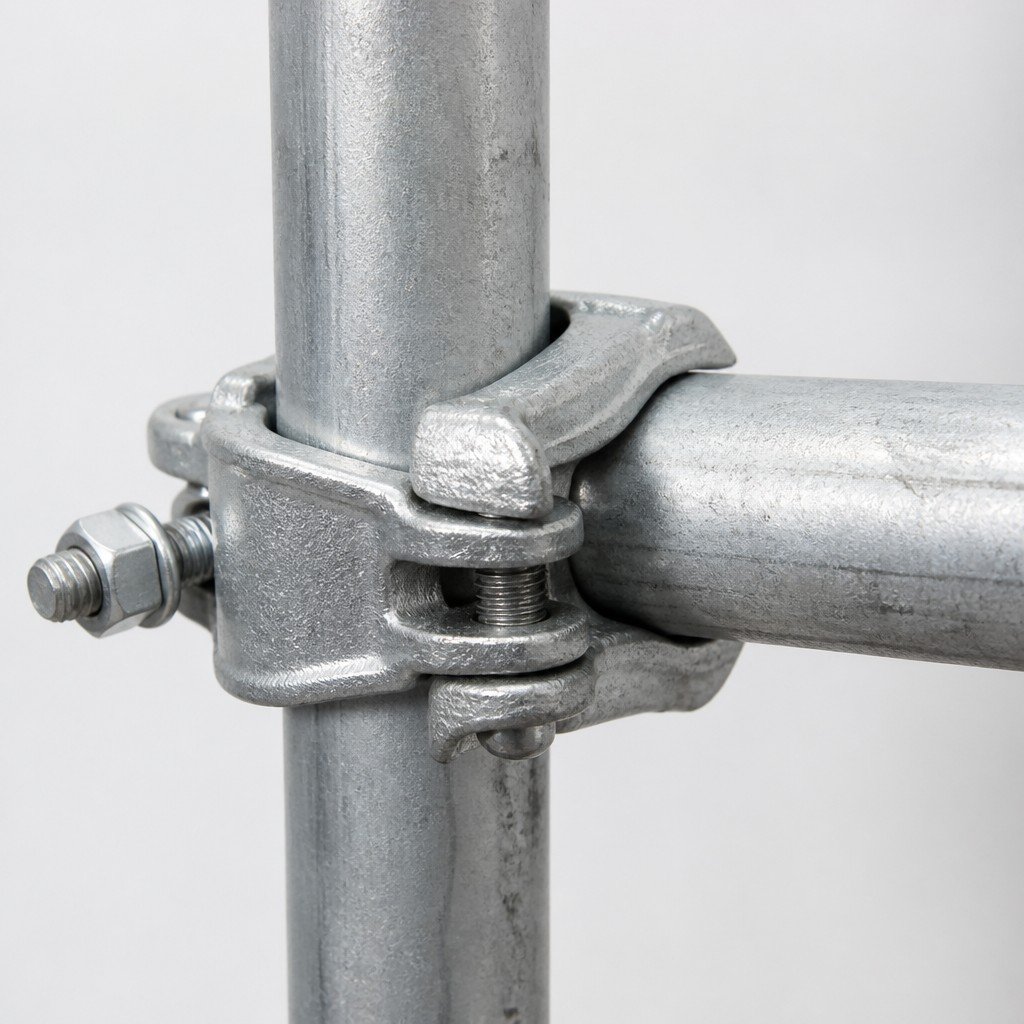
A forged coupler on 48.3 mm tubes. Couplers, wedges and jack spindles are the wear parts of a fleet — order them with the package, and with the correct TN VED position.
Frequently asked questions about scaffolding cost
How much does scaffolding cost in 2026?
Public export references for September 2026 put scaffolding from China at USD 500–1,100 per tonne depending on system and configuration, with marketplace listings at USD 800–1,400 per tonne at a 20-tonne MOQ. For a real project, the useful number is cost per m² of façade: on a 1,200 m² façade, a frame package comes out at roughly USD 25–28 per m² and a modular package at roughly USD 29–31 per m², landed and including duty and VAT.
How much does 1,000 m² of scaffolding weigh?
Using published engineering guidance, a complete frame scaffold weighs about 19–21 kg per m² of scaffolded area and a modular system about 24 kg/m². So 1,000 m² is roughly 19–21 tonnes in frame scaffolding and about 24 tonnes in a modular system. At 15 tonnes per 40HC container, that is two containers either way.
How many m² of scaffolding fit in a 40ft container?
As a working figure, about 15 tonnes of bundled scaffolding fit in a 40HC, which corresponds to roughly 600–750 m² of façade in frame scaffolding and about 620 m² in a modular system. Bundling quality and the mix of standards versus boards change the exact figure, so always ask for a container loading plan.
What are the duty and VAT on imported scaffolding in Russia?
Equipment for metal scaffolding is classified under TN VED 7308 40 000 9, with an import duty of 7.5% in the EAEU common tariff. VAT on import in Russia has been 22% since 1 January 2026 under Federal Law No. 425-FZ of 28 November 2025, applied to the customs value plus duty. Import VAT is normally recoverable for a VAT-registered importer.
Is it cheaper to buy scaffolding or to rent it?
It depends on how many days the fleet works. At current Moscow rental references — about 2.5 RUB per m² per day for frame scaffolding and about 4.5 RUB per m² per day for wedge systems — a frame package pays for itself after roughly 845–935 rental days and a modular package after roughly 540–590 days, both excluding the refundable deposit. Single projects under about 600 rental days are usually cheaper to rent.
Why are two quotes for the same scaffolding 30% apart?
Usually four reasons: tube wall thickness and rosette or coupler quality; galvanizing coating weight; whether accessories and spares are inside the package; and the Incoterm. A per-tonne price cannot show any of them, which is why the comparison has to be made on cost per m² of façade with a stated specification.
How much does it cost to ship scaffolding from China to Russia?
Sea freight on the Shanghai–St Petersburg route has been referenced at USD 3,100–4,323 per 40ft container, and rail routes through Dostyk or Khorgos are quoted per CBM. For a 1,200 m² façade requiring two containers, budget USD 6,200–8,646 of sea freight, on top of the FOB value.
What galvanizing specification should I require?
Hot-dip galvanizing per EN ISO 1461 with a coating of 65–85 µm, equivalent to roughly 450–600 g/m². This gives 10–15 years of outdoor service in Russian and CIS conditions. Coatings of 300–400 g/m² are cheaper per tonne and corrode within 2–3 outdoor seasons.
Can Chinese scaffolding be certified for the Russian market?
Yes. Export mills manufacture to GOST 27321-87 for frame and pin scaffolding or EN 12810-1 for system scaffolding, with mill test certificates per EN 10204 3.1, load test reports and an EAC declaration where the technical regulations apply. The check that matters is documented confirmation in the supply documents and a third-party inspection if the order is large.
What is the minimum order for scaffolding from China?
Our standard minimum is 25 tonnes per size for a mixed programme, although a single-system package can be quoted from one container — around 15 tonnes. Because freight and clearance are paid per container, spreading a first order thinner than a container rarely saves money.
How long does production and delivery take?
Standard production is 20–30 days after specification approval, and sea freight to St. Petersburg or Novorossiysk takes 35–45 days. For a multi-container order on tight schedules, loading can be phased so the first container ships while the remainder is still in production.
Can you calculate the package for my building?
Yes. Send the façade length and height, the application and the required load class through the form below, and an export engineer returns a package calculation with quantities, tonnage, container plan and a factory-direct price within 24 hours.
Scaffolding cost is an engineering number before it is a commercial one: fix the system, the load class and the deck module, and the tonnage — and therefore the price — is determined. Send us the specification template above and we will run the calculation against your actual building, including the container plan and the documents you need for clearance.
Related reading: how to choose between frame, cuplock, ringlock and tube-and-clamp scaffolding, how contractors and rental companies select a scaffolding supplier, the 20-container Ringlock shipment to Russia, and the full scaffolding range with standards and component specifications.
Get a scaffolding package calculation within 24 hours
Send façade length and height, application, required load class and destination port. An export engineer returns quantities, tonnage, container plan and a factory-direct price — with MTC per EN 10204 3.1 and EAC documentation.
Prefer email? Write to [email protected] or call / WhatsApp +86 186 2208 8833. Standards compliance: EN 12810-1, EN 12811-1, EN 10219, EN ISO 1461, GOST 27321-87.