How Much Do Seamless & API 5L Steel Pipes Cost? Price per Tonne, Wall Thickness Calculation and Sourcing Guide (2026)
A comprehensive 2026 procurement guide for engineers, contractors, and pipeline importers: FOB China benchmark bands, seamless vs welded (ERW/LSAW/SSAW) cost mechanics, ASTM A106 Gr. B vs API 5L (PSL1 vs PSL2) technical requirements, exact linear weight calculation formulas, 20GP/40HC container loading limits, and total landed cost breakdown with 5% duty and 22% VAT.
- 1. Key Cost Drivers in Seamless and Line Pipe Manufacturing
- 2. 2026 FOB China Price Benchmarks (Per Tonne)
- 3. Pipe Weight Formula, OD, Wall Thickness & Schedule Reference
- 4. ASTM A106 Gr. B vs API 5L: PSL1 vs PSL2 Quality Comparison
- 5. Worked Example: 100-Tonne Pipeline Project Landed Cost Calculation
- 6. Factory Quality Control, Hydrostatic & NDT Testing Checklist
- 7. Export Bundling, Bevelled Ends, Coating & Container Loading
- 8. Frequently Asked Questions (FAQ)
- 9. Request a Formal Mill Quotation
1. Key Cost Drivers in Seamless and Line Pipe Manufacturing
When sourcing carbon steel seamless pipes (ASTM A106, ASTM A53, GOST 8732) and line pipes (API 5L Grade B through X70), buyers frequently encounter quotation spreads of $120–$250 per metric tonne for what appears to be the same nominal outer diameter. In heavy industrial and energy procurement, pipe cost is determined by seven structural variables:
| Cost Driver | Engineering Impact | Typical Effect on Price per Tonne |
|---|---|---|
| 1. Production Process (Seamless vs Welded) | Hot-rolled / cold-drawn seamless billets vs ERW / SSAW / LSAW rolled strip & heavy plate. | Seamless commands a 20%–40% premium over ERW due to solid billet piercing yields and heating energy. |
| 2. Steel Grade & Micro-Alloying | Standard Carbon (A106B / Gr.B) vs Micro-alloyed High Yield (X52, X60, X65, X70 with Nb, V, Ti additions). | Higher yield strength increases billet cost by $50–$180/t but reduces required wall thickness and overall project tonnage. |
| 3. Product Specification Level (PSL1 vs PSL2) | PSL2 mandates mandatory Charpy V-notch impact testing (-20°C / -40°C), maximum yield-to-tensile ratio, CEV formula, and full-length NDT. | PSL2 adds 8%–15% over PSL1 due to tight metallurgical chemistry controls and mandatory destructive testing coupons. |
| 4. Wall Thickness & Schedule (SCH 10 to SCH 160 / XXS) | Heavy wall (SCH 80, SCH 160) requires multi-pass piercing and sizing; extreme thin wall requires cold finishing. | Standard SCH 40 carries baseline rolling cost; heavy walls (>25 mm) or precision thin walls (<3.5 mm) add $40–$90/t. |
| 5. Non-Destructive Testing (NDT) & Hydrotest | 100% full-body Ultrasonic Testing (UT), Eddy Current (ET), Hydrostatic test at up to 100% SMYS, Magnetic Particle (MPI). | Full automated UT + Hydro testing is standard on certified export mills; additional customer-witnessed testing adds $20–$45/t. |
| 6. External Coating & Internal Lining | Bare with rust preventive black varnish vs 3-Layer Polyethylene (3LPE), 3LPP, Fusion Bonded Epoxy (FBE). | 3LPE anti-corrosion coating adds $18–$35 per square metre of outer surface area depending on thickness (2.5–3.7 mm). |
| 7. Containerization & Length Optimization | Single Random Length (SRL 5.8m for 20GP), Double Random Length (DRL 11.8m for 40HC), or custom fixed lengths. | Ordering fixed 11.8m maximizes 40HC payload up to 26–27 tonnes, reducing ocean freight per tonne by up to 28%. |
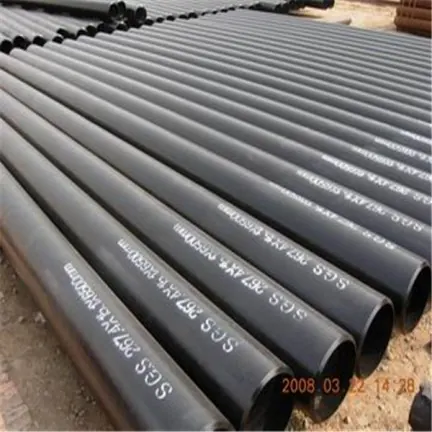
Figure 1: ASTM A106 Grade B seamless carbon steel pipe bundles with factory bevelled ends (30°±5°), plastic end caps, and continuous white paint stencilling showing heat number, size, schedule, and standard.
2. 2026 FOB China Price Benchmarks (Per Tonne)
The following benchmark matrix reflects factory-direct export price bands (FOB Tianjin / Qingdao Port) in October 2026 for commercial export orders with a minimum order quantity (MOQ) of 10–20 metric tonnes per size:
| Product Category & Standard | Size Range (Outer Diameter & Wall) | Steel Grade | FOB China Benchmark (USD/t) |
|---|---|---|---|
| Seamless Carbon Steel Pipe (ASTM A106 / A53) | 1/2″ – 6″ (OD 21.3 – 168.3 mm, SCH 40/80) | ASTM A106 Gr. B / A53 Gr. B | USD 690 – 780 |
| Seamless Heavy-Wall Pipe (ASTM A106 / A335) | 8″ – 24″ (OD 219.1 – 610.0 mm, SCH 80/160) | ASTM A106 Gr. B / Q345B | USD 750 – 860 |
| API 5L Seamless Line Pipe (PSL1) | 2″ – 16″ (OD 60.3 – 406.4 mm, WT 3.9–21.4 mm) | API 5L Grade B, X42, X52 | USD 720 – 820 |
| API 5L Seamless Line Pipe (PSL2, -20°C Impact) | 2″ – 20″ (OD 60.3 – 508.0 mm, WT 4.0–25.0 mm) | API 5L X52N, X60N, X65Q | USD 790 – 920 |
| ERW High-Frequency Welded Pipe (API 5L / A53) | 4″ – 24″ (OD 114.3 – 610.0 mm, WT 4.0–16.0 mm) | Gr. B, X42, X52 (PSL1/PSL2) | USD 620 – 710 |
| LSAW Longitudinal Submerged Arc Welded Pipe | 16″ – 56″ (OD 406.4 – 1422.0 mm, WT 8.0–40.0 mm) | API 5L X52, X60, X65, X70 (PSL2) | USD 730 – 850 |
| SSAW Spiral Submerged Arc Welded Pipe | 8″ – 120″ (OD 219.1 – 3048.0 mm, WT 5.0–25.4 mm) | API 5L Gr. B, X42, X52, X60 | USD 580 – 660 |
| External 3LPE Anti-Corrosion Coating (Application) | 2″ – 48″ Outer Diameter | DIN 30670 / ISO 21809-1 Standard | + USD 90 – 160 / t |
Note: Actual contract prices fluctuate with raw steel billet indexes, molybdenum/vanadium alloy surcharges, exchange rates, and batch volume. Orders over 100 tonnes per single size receive tiered mill discounts of $15–$35/tonne.
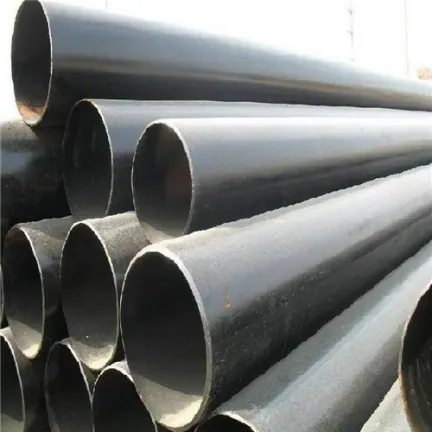
Figure 2: API 5L line pipes stored in Tianjin export terminal with external yellow 3-Layer Polyethylene (3LPE) coating, bevelled end protection, and dedicated wooden dunnage separating tiers.
3. Pipe Weight Formula, OD, Wall Thickness & Schedule Reference
Steel pipe procurement is quoted and billed by weight (metric tonnes), but engineered and installed by linear metres. Calculating the exact theoretical weight per metre is vital to avoid payload discrepancies, transport underfilling, and customs valuation disputes.
Theoretical Linear Weight Formula
The standard metallurgical formula for carbon and low-alloy steel circular pipes is:
W = 0.02466 × (D − t) × t
- W = Theoretical weight per linear metre in kilograms (kg/m)
- D = Outer Diameter in millimetres (mm)
- t = Nominal Wall Thickness in millimetres (mm)
- 0.02466 = Mathematical constant derived from steel density ρ = 7.85 g/cm³ (π × 7.85 ÷ 1,000)
Standard ANSI/ASME B36.10M Size & Weight Reference Table
| NPS (Nominal Pipe Size) | Outer Diameter (mm) | Schedule (SCH) | Wall Thickness (mm) | Linear Weight (kg/m) | Pieces per 20t (at 11.8m) |
|---|---|---|---|---|---|
| 1″ (DN 25) | 33.4 mm | SCH 40 / STD | 3.38 mm | 2.50 kg/m | 678 pcs |
| 2″ (DN 50) | 60.3 mm | SCH 40 / STD | 3.91 mm | 5.44 kg/m | 311 pcs |
| 3″ (DN 80) | 88.9 mm | SCH 40 / STD | 5.49 mm | 11.29 kg/m | 150 pcs |
| 4″ (DN 100) | 114.3 mm | SCH 40 / STD | 6.02 mm | 16.07 kg/m | 105 pcs |
| 6″ (DN 150) | 168.3 mm | SCH 40 / STD | 7.11 mm | 28.26 kg/m | 60 pcs |
| 8″ (DN 200) | 219.1 mm | SCH 40 / STD | 8.18 mm | 42.53 kg/m | 40 pcs |
| 10″ (DN 250) | 273.0 mm | SCH 40 / STD | 9.27 mm | 60.31 kg/m | 28 pcs |
| 12″ (DN 300) | 323.8 mm | SCH 40 / STD | 10.31 mm | 79.73 kg/m | 21 pcs |
| 16″ (DN 400) | 406.4 mm | SCH 40 / STD | 12.70 mm | 123.30 kg/m | 13 pcs |
4. ASTM A106 Gr. B vs API 5L: PSL1 vs PSL2 Quality Comparison
One of the most frequent procurement ambiguities is determining when ASTM A106 Grade B is sufficient and when API 5L PSL2 line pipe must be specified. While both standards share similar base carbon-manganese metallurgy, their qualification criteria diverge significantly:
| Parameter / Requirement | ASTM A106 Grade B | API 5L Grade B (PSL1) | API 5L X52 / X65 (PSL2) |
|---|---|---|---|
| Primary Application | High-temperature industrial piping, boilers, power plants, refineries. | Standard liquid and gas transmission lines at moderate pressures. | High-pressure oil & gas transmission, sour service, offshore & arctic pipelines. |
| Minimum Yield Strength | ≥ 240 MPa (35,000 psi) | ≥ 245 MPa (35,500 psi) | X52: ≥ 360 MPa | X65: ≥ 450 MPa |
| Yield-to-Tensile Ratio (Rt/Rm) | Not specified | Not specified | Mandatory ≤ 0.93 (prevents brittle failure) |
| Charpy V-Notch Impact Test | Optional / supplemental only | Not mandatory | Mandatory: Full temperature curve (-20°C / -40°C, ≥ 27J min ave) |
| Carbon Equivalent (CEV / Pcm) | Not strictly capped for weldability | Max CEV ≤ 0.43 | Max CEV ≤ 0.42 / Pcm ≤ 0.25 (exceptional field weldability) |
| Non-Destructive Testing (NDT) | Hydrotest or Eddy Current / UT | Hydrotest mandatory; NDT optional | 100% Full Body UT / RT + Hydrotest mandatory |
| Certification Standard | MTC EN 10204 3.1 | MTC EN 10204 3.1 | MTC EN 10204 3.1 or 3.2 (Third Party) |
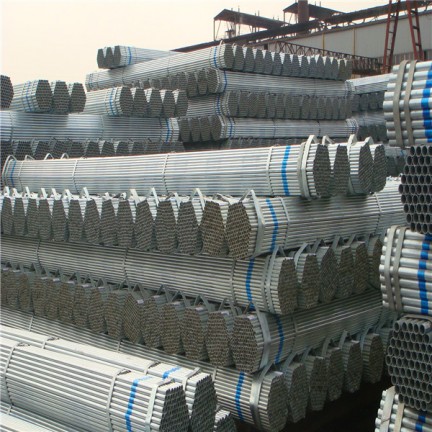
Figure 3: Quality control inspection of 8-inch SCH 40 seamless steel pipes. Ultrasonic wall thickness gauging verifies ±10% tolerance compliance prior to MTC 3.1 sign-off.
5. Worked Example: 100-Tonne Pipeline Project Landed Cost Calculation
To understand the total cost structure from the mill in Tianjin to the final destination port or rail terminal in the Eurasian / CIS region, consider a realistic case study for 100 metric tonnes of 8″ (OD 219.1 mm × WT 8.18 mm SCH 40) API 5L Grade B PSL2 Seamless Line Pipe.
Step 1: Engineering Conversion to Total Length
- Unit Linear Weight: $0.02466 imes (219.1 – 8.18) imes 8.18 = 42.53 ext{ kg/m}$
- Total Meters in 100 Tonnes: $100,000 ext{ kg} \div 42.53 ext{ kg/m} = 2,351.3 ext{ meters}$
- Total Number of Pipes (11.8m Fixed Length): $2,351.3 ext{ m} \div 11.8 ext{ m/pc} = 200 ext{ pieces}$
Step 2: Container Loading Optimization (40ft High Cube Container)
- An 8″ pipe has an OD of 219.1 mm. A 40HC container can safely nest 50 pieces in 5 layers of 10 pipes using protective dunnage and strapping.
- Weight per 40HC Container: $50 ext{ pcs} imes 11.8 ext{ m} imes 42.53 ext{ kg/m} = 25.09 ext{ metric tonnes}$.
- Total Containers Required: $100 ext{ tonnes} \div 25.09 ext{ tonnes/container} = \mathbf{4 imes 40 ext{HC Containers}}$ (100% container weight capacity utilized).
Step 3: Complete Landed Cost Breakdown (CIF Novorossiysk / Saint Petersburg)
| Cost Component | Unit Calculation | Subtotal (USD) | Share of Total |
|---|---|---|---|
| 1. Factory FOB Cost (Tianjin Port) | 100.36 tonnes × $760 / tonne | $76,273.60 | 64.2% |
| 2. Ocean Freight (4 × 40HC Container) | 4 × $2,450 / 40HC (Tianjin to destination) | $9,800.00 | 8.3% |
| 3. Marine Cargo Insurance (All Risks, 110%) | $86,073.60 × 0.25% | $215.18 | 0.2% |
| CIF Destination Port Value | FOB + Freight + Insurance | $86,288.78 | 72.7% |
| 4. Customs Import Duty (5.0%) | 5% on CIF Customs Value ($86,288.78) | $4,314.44 | 3.6% |
| 5. Port Handling & Customs Brokerage | 4 Containers × $380 / container | $1,520.00 | 1.3% |
| 6. Import Value-Added Tax (VAT 22%) | 22% on (CIF Value + Duty) = 22% × $90,603.22 | $19,932.71 | 16.8% |
| 7. Domestic On-Carriage (Trucking 300 km) | 4 Containers × $1,150 / container | $4,600.00 | 3.9% |
| Total Landed Cost Delivered Duty Paid (DDP) | All Inclusive Delivered to Site | $118,175.93 | 100.0% |
| Effective Landed Cost per Tonne | $118,175.93 ÷ 100.36 metric tonnes | $1,177.52 / t | — |
Key Takeaway: The FOB mill price represents approximately 64% of the final landed cost. Maximizing container payload (reaching 25+ tonnes per 40HC) saves up to $35/tonne compared to loose or poorly bundled shipments.
6. Factory Quality Control, Hydrostatic & NDT Testing Checklist
To eliminate pipeline installation failures and ensure complete regulatory compliance, Sino East Steel enforces a rigorous multi-stage quality protocol verified by Mill Test Certificates per EN 10204 3.1:
Pre-Shipment Quality Protocol Checklist
- Chemical Composition Verification: Optical Emission Spectrometry (OES) analysis per heat number for C, Si, Mn, P, S, Cr, Mo, Ni, Cu, V, Nb, Ti, and Carbon Equivalent (CEV).
- Mechanical Tensile Testing: Yield strength ($R_t0.5$), ultimate tensile strength ($R_m$), elongation ($A\%$), and yield-to-tensile ratio verification at room temperature.
- Charpy V-Notch Impact Test: Longitudinal/transverse sub-size or full-size specimens tested at 0°C, -20°C, or -40°C for toughness validation.
- Hydrostatic Pressure Testing: 100% of pipes tested for a minimum of 5 seconds. Pressure calculated per Barlow’s formula: $P = rac{2 S t}{D} imes 0.90$ (testing up to 90%–100% of SMYS).
- Non-Destructive Testing (NDT): Automated full-body ultrasonic testing (UT per ISO 10893-8 / ASTM E213) to detect longitudinal and transverse laminations and wall thinning.
- Dimensional & Visual Audit: Laser measurement of Outer Diameter (±0.75%), Wall Thickness (+15% / -12.5%), Out-of-Roundness (≤ 1.5%), Straightness (≤ 1.5 mm/m), and Bevel Angle (30° to 35° with 1.6 mm root face).
7. Export Bundling, Bevelled Ends, Coating & Container Loading
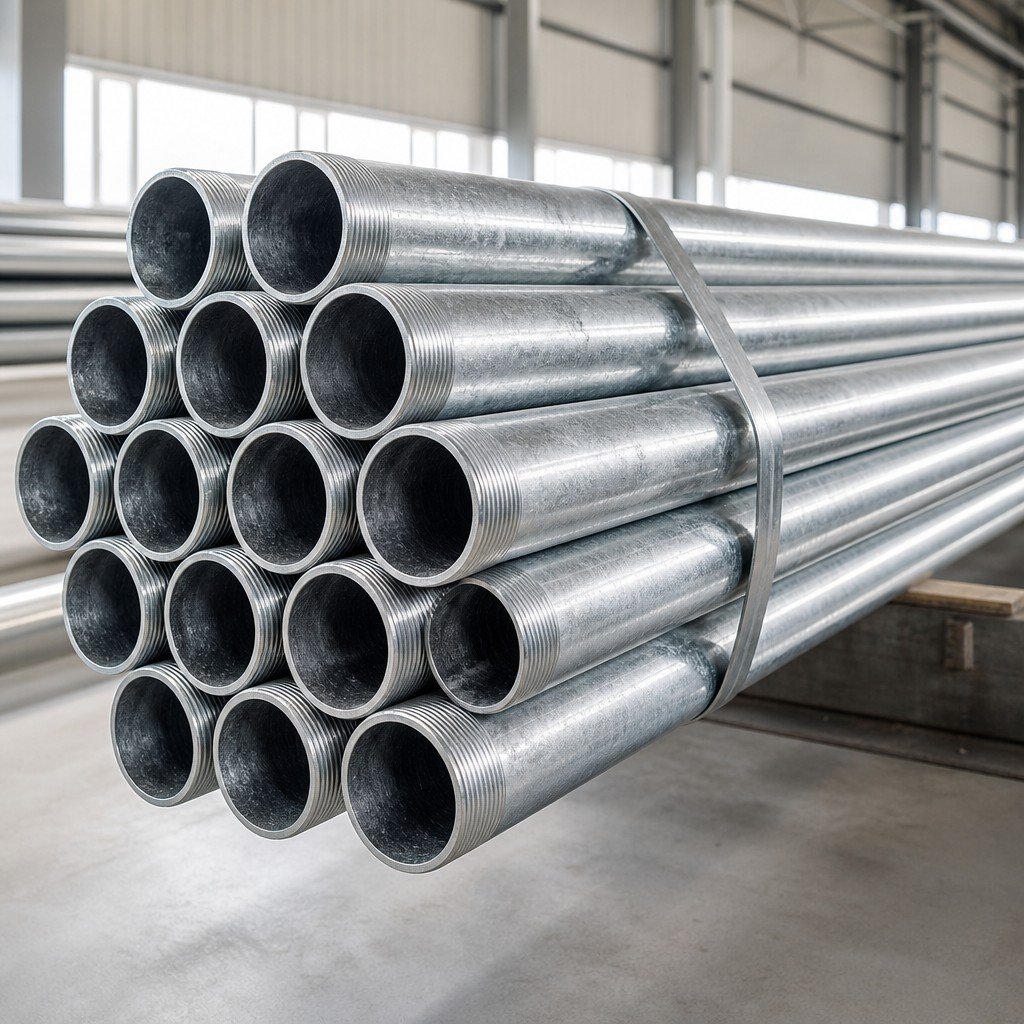
Figure 4: Hexagonal export bundles of seamless pipes secured with high-tensile steel straps, lifting slings, and protective heavy-duty plastic end caps to prevent thread and bevel damage during maritime transit.
| Pipe Size Range | Export Packaging Method | End Protection | Recommended Transport Mode |
|---|---|---|---|
| 1/2″ – 3″ (OD 21.3 – 88.9 mm) | Hexagonal bundles (1.5–3.0 tonnes) tied with min. 6 high-tensile steel straps + 2 nylon lifting slings. | Plastic end caps on both ends. | 20GP (5.8m lengths) or 40HC (11.8m lengths). |
| 4″ – 8″ (OD 114.3 – 219.1 mm) | Smaller square or hexagonal bundles (3–7 pipes per bundle) or loose nested. | Recessed plastic or steel bevel protectors. | 40HC container with internal timber dunnage. |
| 10″ – 24″ (OD 273.0 – 610.0 mm) | Loose loaded, individually supported with wooden wedges and rubber cushions. | Heavy-duty metal bevel protection rings. | 40HC or Breakbulk / Open Top for over-length. |
| 26″ – 60″+ (LSAW / SSAW) | Loose loaded in ship’s hold with cross-stowage securing and padding. | Bevel protection rings + end hooks. | Breakbulk vessel (bulk carrier charter). |
8. Frequently Asked Questions (FAQ)
What is the difference between ASTM A106 Grade B and ASTM A53 Grade B?
ASTM A106 is exclusively a seamless pipe specification designed specifically for high-temperature and high-pressure service (e.g., power generation, refineries, steam boilers). ASTM A53 covers both seamless and welded (ERW) steel pipes intended for general commercial, structural, and low-pressure plumbing or HVAC applications. A106 has stricter carbon and silicon controls for thermal resistance.
What is the minimum order quantity (MOQ) for factory-direct pipe orders from China?
For standard stock sizes (OD 1/2″ to 12″, SCH 40/80 in ASTM A106B / API 5L Gr.B), the MOQ is typically 5 to 10 metric tonnes per size. For customized production runs, special wall thicknesses, high grades (API 5L X65/X70), or 3LPE coated pipes, the standard mill production MOQ is 20 to 25 metric tonnes (one full 20GP or 40HC container payload).
How do I verify the authenticity of a Mill Test Certificate (MTC 3.1)?
Every Sino East Steel MTC EN 10204 3.1 includes an embossed QR verification code, traceable Heat Number, Mill Order Number, mechanical test results, chemical composition, and Chief Inspector signature. Third-party inspection agencies such as SGS, Bureau Veritas (BV), TÜV, or client-appointed inspectors can be commissioned to witness hydrostatic testing and ladle analysis prior to container loading.
What is the standard lead time for manufacturing and shipping seamless pipes?
Standard carbon steel pipes in common schedules are dispatched from Tianjin factory stock within 7 to 10 business days. Custom production orders (API 5L PSL2, specific alloy additions, or external 3LPE coating) typically require 20 to 30 days for rolling, testing, and coating, followed by ocean transit times of 20–35 days depending on the destination port.
Request an Official Mill Quotation (24-Hour Turnaround)
Submit your required outer diameter, wall thickness, steel grade, and tonnage. Our commercial export desk will return a detailed FOB / CIF calculation with container stuffing plan and MTC sample within 24 hours.